
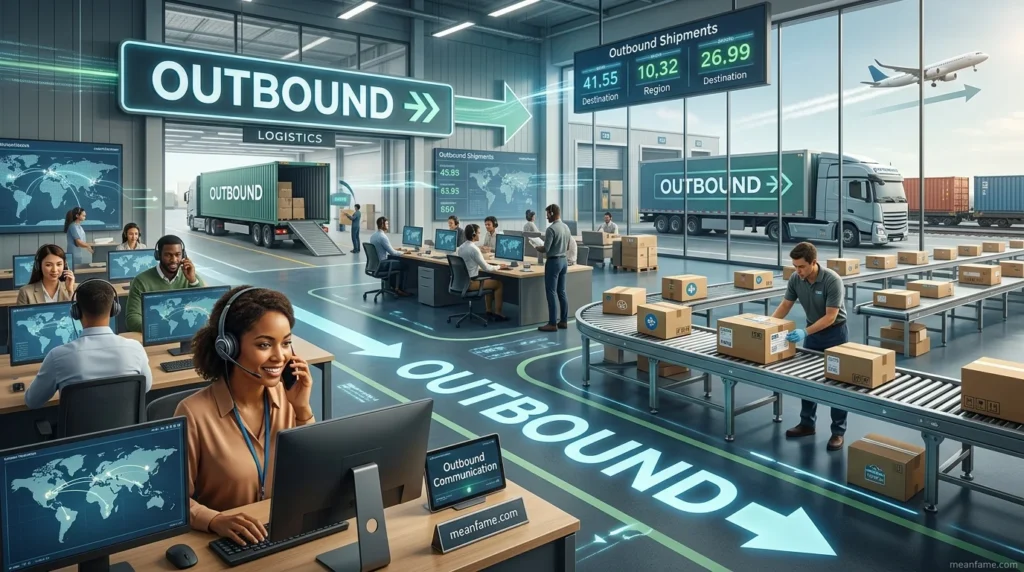

What Does “Outbound” Mean?
Quick Definition
Outbound means going out, leaving, departing, or moving away from a specific place, organization, or source.
Literal Meaning
The word combines:
- Out = away from
- Bound = headed toward a destination
Together, outbound means “traveling away from the point of origin.”
Modern Meaning
Today, outbound can refer to:
- Flights leaving an airport
- Packages being shipped
- Sales calls made to customers
- Marketing efforts targeting prospects
- Data leaving a network
What Tone Does It Convey?
Outbound is usually:
- Neutral
- Professional
- Operational
- Business-focused
Unlike slang terms, outbound rarely carries emotional meaning.
What Does Outbound Mean in Different Contexts?
Travel
In travel, outbound refers to the first leg of a journey departing from the starting location.
Example:
“Your outbound flight leaves New York at 8:00 AM.”
Logistics and Shipping
In logistics, outbound describes products or shipments leaving a warehouse or distribution center.
Example:
“The outbound shipment is scheduled for delivery tomorrow.”
Sales
In sales, outbound refers to sales representatives proactively contacting potential customers.
Example:
“Our outbound sales team generated 200 leads this month.”
Marketing
Outbound marketing involves reaching customers through advertising and direct promotion.
Examples include:
- TV ads
- Cold emails
- Cold calls
- Direct mail campaigns
Customer Service
Outbound customer service means agents initiate contact with customers.
Example:
“The company made outbound calls to confirm appointments.”
Technology
In networking, outbound traffic refers to data leaving a computer system or network.
Example:
“The firewall monitors all outbound traffic.”
Origin and History of Outbound
The word outbound has been used in English for centuries.
Early Usage
Historically, outbound described ships departing from ports and heading toward other destinations.
Example:
“The outbound vessel departed at dawn.”
Transportation Expansion
As railways, airlines, and public transportation developed, the term became common in travel industries.
Modern Business Usage
Today, outbound is widely used in:
- Sales
- Marketing
- Logistics
- Technology
- Customer support
Its meaning remains centered around the idea of movement away from a source.
How People Actually Use Outbound
Most people encounter outbound in professional settings.
You’ll commonly see it in:
- Flight bookings
- Shipping updates
- Sales reports
- Marketing strategies
- Call center operations
When to Use It
Use outbound when describing:
- Departures
- Shipments leaving
- Proactive customer outreach
- Traffic moving outward
Examples:
- “The outbound flight is delayed.”
- “Our outbound marketing campaign starts next week.”
- “Outbound calls increased this quarter.”
When Not to Use It
Avoid using outbound when discussing:
- Incoming activity
- Receiving products
- Customer inquiries coming in
In those situations, inbound is usually the correct term.
Real Examples of Outbound in Conversations
Example 1
Person A: When does your trip start?
Person B: My outbound flight leaves Friday morning.
Meaning: The departing flight.
Example 2
Person A: Has my order shipped?
Person B: Yes, it’s currently in outbound processing.
Meaning: Preparing to leave the warehouse.
Example 3
Person A: How did you find new clients?
Person B: Through outbound sales calls.
Meaning: Calls initiated by the company.
Example 4
Person A: What’s your marketing strategy?
Person B: We focus on outbound advertising.
Meaning: Reaching customers proactively.
Example 5
Person A: Did support contact customers?
Person B: Yes, they made outbound calls today.
Meaning: Calls placed to customers.
Example 6
Person A: Why is the package delayed?
Person B: It’s waiting in the outbound shipping queue.
Meaning: Awaiting shipment.
Example 7
Person A: Is network activity normal?
Person B: Outbound traffic looks stable.
Meaning: Data leaving the system.
Example 8
Person A: Which ticket should I check first?
Person B: Verify the outbound journey details.
Meaning: Departure segment.
Example 9
Person A: How do you generate leads?
Person B: Mostly through outbound prospecting.
Meaning: Reaching out to potential customers.
Example 10
Person A: Has the shipment left?
Person B: The outbound truck departed this morning.
Meaning: Transportation leaving the facility.
Common Mistakes and Misunderstandings
Confusing Outbound with Inbound
This is the most common mistake.
- Outbound = Going out
- Inbound = Coming in
Assuming It’s Only About Travel
Many people think outbound only applies to flights.
In reality, it’s widely used in business, technology, logistics, and marketing.
Using It for Incoming Calls
Outbound calls are initiated by the company.
Calls received by a company are inbound calls.
Similar Terms and Related Words
| Term | Meaning | Difference |
|---|---|---|
| Inbound | Coming in | Opposite of outbound |
| Departure | Leaving a place | Mainly travel-related |
| Shipment | Goods being transported | More specific |
| Dispatch | Sending something out | Often logistics-related |
| Export | Sending goods abroad | International focus |
| Delivery | Transporting goods | Focuses on arrival |
| Prospecting | Finding customers | Sales-specific |
| Outreach | Contacting people | Communication-focused |
| Distribution | Moving products | Broader logistics term |
| Transit | Movement between locations | Includes both directions |
Is Outbound Positive, Negative, or Neutral?
Outbound is generally a neutral term.
Positive Uses
- Business growth
- Marketing campaigns
- Successful shipments
- Customer engagement
Neutral Uses
- Flight schedules
- Shipping reports
- Network monitoring
Negative Uses
The term itself is not negative, but context can be.
Example:
“Outbound deliveries were delayed.”
The delay is negative, not the word outbound.
Should You Use the Word Outbound?
Use It If
- You’re discussing departures.
- You’re talking about shipping.
- You’re describing sales outreach.
- You’re referring to outgoing communications.
Avoid It If
- You mean incoming activity.
- You are describing receiving goods.
- You’re talking about customers contacting you first.