

What Does “Landslide” Mean?
Quick Definition
Landslide refers to (1) the downward sliding of a mass of rock, soil, or earth on or from a steep slope, or (2) an election or contest in which one person or party wins by an overwhelmingly large margin .
What It Usually Means In Conversations
When people use the word landslide in everyday conversation, they’re usually talking about one of two things:
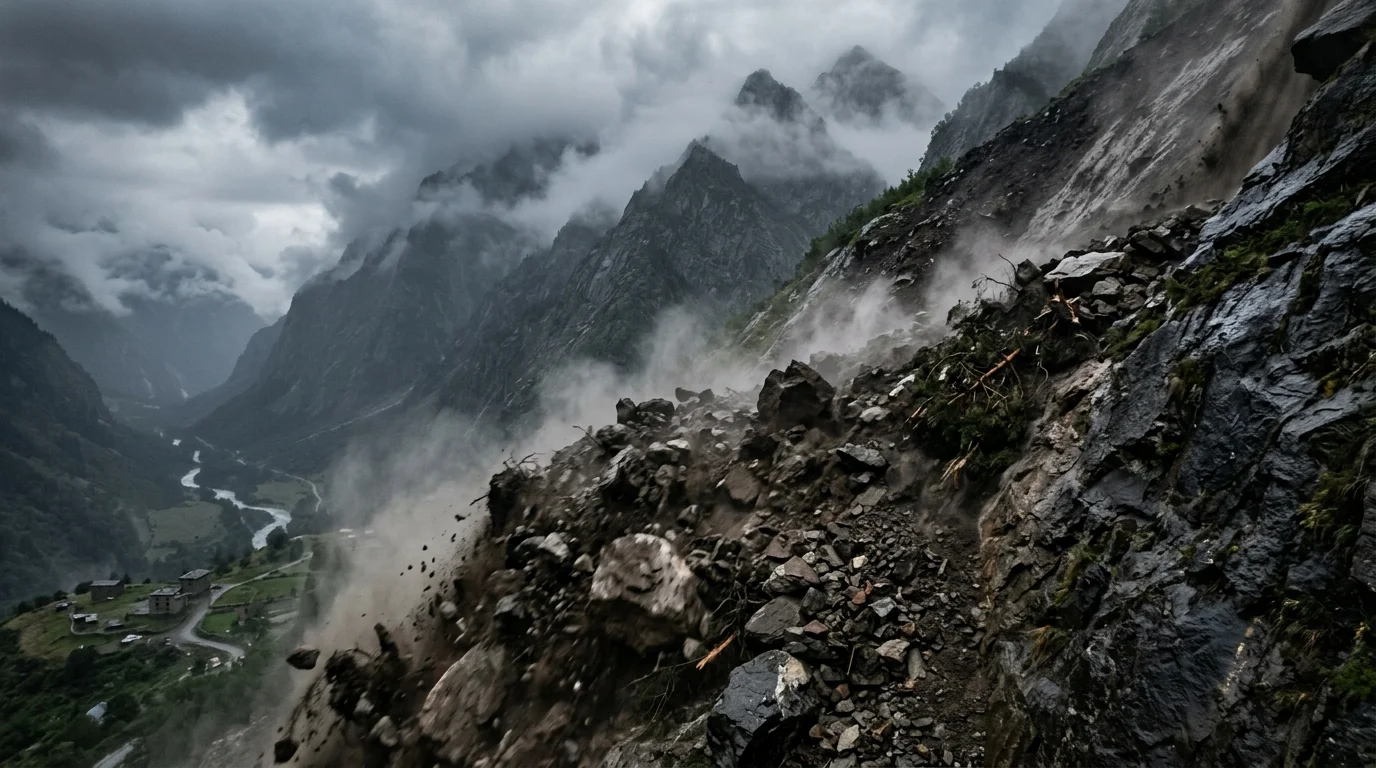
The geological meaning: When a mass of dirt, rocks, or debris slides down the side of a mountain or cliff. This is the original and literal landslide meaning .
The political/figurative meaning: When a candidate or team wins by a huge margin. For example, “She won the election by a landslide” means she got far more votes than her opponent .
The landslide meaning can sometimes cause confusion because the same word describes both a destructive natural event and a triumphant victory. But once you know the context, it’s usually pretty clear which meaning someone is using.
What Tone Does It Convey?
The tone of landslide depends entirely on the context:
| Context | Tone | Example |
|---|---|---|
| Geological disaster | Neutral, serious | “The earthquake triggered a landslide that buried the road” |
| Political victory | Positive (for the winner), negative (for the loser) | “The party won a landslide victory in the election” |
| Sports victory | Positive, exciting | “They won the championship by a landslide” |
| Informational | Neutral | “Landslides are caused by gravity and erosion” |
| Historical | Neutral, factual | “The 1936 landslide for Roosevelt” |
What Does Landslide Mean on Different Platforms?
Text Messages
In texts, landslide is rarely used in the geological sense. You’re more likely to see it when someone’s talking about a sports win or an election result.
Example: “Did you see the game? Total landslide, 42-7.”
Snapchat
On Snapchat, you might see landslide used in captions when sharing news about a big win or a dramatic event. It could be a sports victory, a political meme, or even a video of actual mudslides if someone’s posting from a storm-affected area.
Example: A snap of a celebration with the caption “Landslide victory vibes.”
Instagram users often use landslide in captions and stories to celebrate wins, whether it’s a team victory, a personal achievement, or reacting to election results.
Example: “We did it! Landslide win for the team.”
TikTok
On TikTok, creators use landslide in videos discussing politics, sports, or even dramatic wins in reality competitions. The term often appears with clips of celebrations or, ironically, with footage of actual landslides set to dramatic music.
Example: A political commentary video titled “How this election became a landslide.”
Discord
In Discord servers, especially gaming communities, landslide is often used to describe a match where one team completely dominates the other. It’s also common in political discussion channels during election season.
Example: “That was a landslide. They didn’t stand a chance.”
Reddit is where you’ll find detailed discussions about both meanings of landslide. Subreddits like r/geology talk about the science of landslides, while r/politics uses the term constantly during election cycles.
Example: “Can we stop calling every election a landslide when it’s only a 5-point win?”
Dating Apps
On dating apps, landslide is less common, but you might see it in bios from politically active people or sports fans.
Example: “Still celebrating that landslide win last night. Go team!”
Origin and History of Landslide
The word landslide has an interesting history that actually explains why it has two distinct meanings today.
1830s–1840s: The term first appeared in American English around 1830–1840 as a combination of “land” and “slide” . It was originally used by geologists to describe the sudden collapse of a land mass . Before this, the British used the term “landslip” (1670s) for the same phenomenon, and Old English used “eorðgebyrst,” which literally meant “earth-burst” .
1888: The political landslide meaning emerged. The term was first used in politics to describe an overwhelming electoral victory .
1890: One of the earliest cited uses of the political landslide meaning appeared in the Washington Post, which noted that “Both parties have in the past shouted over landslide victories, and each party has seen its landslide victory soon turned into overwhelming defeat” .
Since then, the political landslide meaning has become just as common as the geological one. Today, when someone says landslide, you really have to pay attention to context to know whether they’re talking about dirt and rocks or votes and victories.
How People Actually Use Landslide
When to Use It
Use the geological meaning when:
Describing actual landslides caused by rain, earthquakes, or erosion
Discussing natural disasters or environmental events
Talking about geology, earth science, or weather-related phenomena
Explaining the science of slope movement
Use the political/figurative meaning when:
Describing election results where one candidate wins by a large margin
Talking about a decisive victory in sports or competitions
Emphasizing the scale of a win or defeat
Making historical comparisons (e.g., “the 1936 landslide for Roosevelt”)
When Not to Use It
You might want to avoid using landslide in these situations:
Describing a close race or narrow victory: If someone wins by just a few points, calling it a landslide would be inaccurate. It specifically means an overwhelming majority .
In formal scientific contexts without precision: Geologists use very specific terms for different types of slope movement (falls, topples, slides, spreads, flows) .
When discussing natural disasters insensitively: If you’re talking about an actual landslide that caused deaths or property damage, using it as a metaphor for a sports victory nearby might come across as tone-deaf.
Real Examples of Landslide in Conversations and Contexts
Example 1: Political Victory
Person A: “Who won the election?”
Person B: “Governor Martinez won by a landslide. She got 70% of the vote.”
Meaning: Governor Martinez won by an overwhelming majority.
Why it was used: To emphasize the scale of the victory.
Example 2: Natural Disaster
Person A: “Why is the highway closed?”
Person B: “A landslide covered the road after all that rain last night.”
Meaning: A mass of earth and rock slid down the hillside onto the road .
Why it was used: To explain a physical event causing a road closure.
Example 3: Sports
Person A: “How was the game?”
Person B: “Total landslide. We won 48-10.”
Meaning: The winning team dominated.
Why it was used: To emphasize how one-sided the competition was.
Example 4: Historical Reference
Person A: “Was it a close election?”
Person B: “No way. It was the biggest landslide since Roosevelt in 1936.”
Meaning: A reference to one of the most famous landslide victories in U.S. history .
Why it was used: Historical comparison to emphasize the scale of victory.
Example 5: Scientific Explanation
Person A: “What causes landslides?”
Person B: “Usually heavy rain, earthquakes, or erosion that weakens the slope. Gravity does the rest.”
Meaning: An explanation of the geological process.
Why it was used: To educate someone about the natural phenomenon.
Example 6: Competition Win
Person A: “Did you enter that baking contest?”
Person B: “Yeah, and it was a landslide. Nobody else even came close.”
Meaning: Person B won by a huge margin.
Why it was used: To brag about a decisive victory.
Example 7: Political Commentary
Person A: “The pundits are calling it a landslide.”
Person B: “They always say that. A 5-point margin isn’t a landslide.”
Meaning: A debate about whether the election result qualifies as a landslide.
Why it was used: To discuss the accuracy of the term.
Example 8: News Report
Person A: “I saw the news. The landslide buried several homes.”
Person B: “That’s terrifying. I hope everyone’s okay.”
Meaning: A discussion of an actual geological event with real consequences.
Why it was used: To express concern about a natural disaster.
Common Mistakes and Misunderstandings
Confusing the Two Meanings
This is by far the most common mistake. Someone might read about a “landslide” and assume it’s political when it’s actually geological, or vice versa. The landslide meaning is completely different depending on context.
Example of confusion: You read “The landslide caused extensive damage to the area” and think it’s about an election destroying a politician’s career. But it’s actually about rocks and dirt destroying roads and buildings.
Overusing the Political Meaning
Pundits and commentators often call every election a “landslide” when the margin isn’t actually that large. A true landslide means an overwhelming majority, not just a comfortable win .
Thinking It Only Applies to Elections
The political landslide meaning is very common, but the word originally described geological events and is still widely used that way. Don’t forget that the literal landslide meaning is about earth movement .
Misunderstanding the Science
Not all slope movements are landslides. Geologists classify mass wasting into falls, topples, slides, spreads, and flows. A landslide is just one type .
Similar Slang Terms and Related Words
Here are words and concepts that are similar to or related to the landslide meaning.
| Word/Concept | Meaning | Difference from Landslide |
|---|---|---|
| Landslip | British term for the geological event | The same meaning, just preferred in British English |
| Mudslide | A landslide involving mud | A specific type of landslide |
| Rockslide | A landslide involving rocks | Another specific type of landslide |
| Debris flow | Fast-moving landslide with debris | A more technical geological classification |
| Avalanche | Snow and ice moving down a slope | Different material (snow/ice vs. earth/rock) |
| Walkover | An easy victory | Similar to the figurative meaning but less dramatic |
| Decisive win | A clear, unambiguous victory | Less specific than landslide, which implies a huge margin |
| Overwhelming victory | A victory by a large margin | Often used interchangeably with landslide |
| Mass wasting | The geological term for downslope movement | Broader term; landslide is one type |
| Tsunami | Ocean waves caused by earthquakes | Can be caused by submarine landslides |
Is Landslide Positive, Negative, or Neutral?
The landslide meaning itself is neutral, but its emotional weight depends entirely on context:
Positive Landslide:
When your favorite candidate or team wins by a landslide, it feels amazing
A landslide victory in sports is celebrated by fans
A decisive win can be seen as validation or success
Negative Landslide:
An actual geological landslide is destructive and potentially deadly
A political landslide for the other side can be devastating
The term can be used as a threat in political rhetoric (“a deadly landslide is coming”)
Neutral Landslide:
Scientific discussions about geological processes
Historical references to past elections
Should You Use Landslide?
You might use it if:
Describing an election where one candidate won by an overwhelming majority
Talking about a decisive victory in sports or competitions
Explaining geological events like the movement of soil and rock
Discussing news stories about natural disasters
Comparing historical elections or political events
You should avoid it if:
Describing a close race or narrow victory
Using it when you mean “landslip” in formal British writing
Discussing a sensitive situation where a natural disaster caused significant damage and loss of life, and you’re using the term casually