

What Does Fraction Mean?
Quick Definition
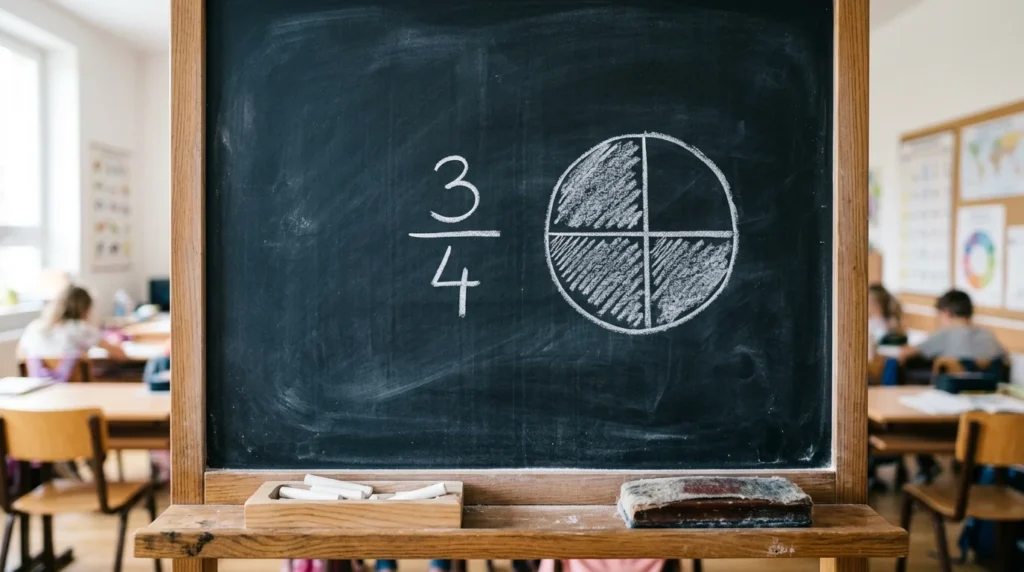
The fraction meaning is a numerical expression that represents a part of a whole or a portion of a group. A fraction is written as one number over another, separated by a horizontal line.
For example:
- 1/2 means one out of two equal parts.
- 3/4 means three out of four equal parts.
- 5/8 means five out of eight equal parts.
Understanding the Parts of a Fraction
Every fraction has two important components:
Numerator
The numerator is the top number.
Example:
In 3/5, the number 3 is the numerator.
It tells us how many parts are being considered.
Denominator
The denominator is the bottom number.
Example:
In 3/5, the number 5 is the denominator.
It tells us how many equal parts make up the whole.
What Fraction Usually Means in Math
The most common fraction meaning in mathematics is a representation of division.
For example:
- 1/2 means 1 divided by 2.
- 3/4 means 3 divided by 4.
- 7/10 means 7 divided by 10.
This interpretation helps explain why fractions can also be converted into decimals and percentages.
What Does a Fraction Represent?
A fraction can represent:
- A portion of an object
- A section of a group
- A measurement
- A ratio
- A probability
Because of this flexibility, fractions are used in nearly every area of mathematics.
Different Types of Fractions
Understanding fraction meaning becomes easier when you know the different types of fractions.
Proper Fractions
A proper fraction has a numerator smaller than its denominator.
Examples:
- 1/2
- 2/5
- 3/8
These fractions are always less than 1.
Improper Fractions
An improper fraction has a numerator greater than or equal to its denominator.
Examples:
- 5/4
- 7/3
- 9/9
These fractions are equal to or greater than 1.
Mixed Fractions
A mixed fraction combines a whole number and a fraction.
Examples:
- 1 1/2
- 2 3/4
- 5 1/8
Mixed fractions are often used in cooking and measurements.
Equivalent Fractions
Equivalent fractions represent the same value.
Examples:
- 1/2 = 2/4
- 3/6 = 1/2
- 4/8 = 1/2
Although the numbers look different, the value remains the same.
Unit Fractions
A unit fraction has a numerator of 1.
Examples:
- 1/2
- 1/3
- 1/10
Unit fractions are commonly used when introducing the fraction meaning to beginners.
How Fractions Are Used in Everyday Life
Many people assume fractions are only useful in school. In reality, the fraction meaning applies to countless daily activities.
Cooking and Baking
Recipes frequently use fractions.
Examples:
- 1/2 cup of milk
- 3/4 teaspoon of salt
- 1/4 cup of sugar
Without understanding fractions, following recipes would be much more difficult.
Shopping
Fractions appear in discounts and sales.
Examples:
- Half-price sales
- Quarter-off promotions
- Buy one and get half off
Construction
Builders use fractions when measuring materials.
Examples:
- 1/4 inch
- 1/2 inch
- 3/8 inch
Precision measurements often depend on fractions.
Time Management
Fractions help describe portions of time.
Examples:
- Half an hour
- Quarter of an hour
- Three-quarters of an hour
Finance
Financial calculations frequently involve fractions.
Examples:
- Interest rates
- Stock ownership
- Investment percentages
Origin and History of Fractions
The fraction meaning has existed for thousands of years.
Ancient Egypt
Ancient Egyptians used fractions as early as 1800 BCE.
Their mathematical documents show extensive use of fractional calculations.
Ancient Greece
Greek mathematicians expanded fraction concepts and applied them to geometry and science.
Roman Empire
Romans used fractions for trade, measurements, and commerce.
Medieval Mathematics
As mathematics developed across Europe, Asia, and the Middle East, fractions became a standard tool for calculations.
Modern Mathematics
Today, fractions remain essential in education, engineering, science, finance, and technology.
How People Actually Use Fractions
Most people use fractions without even thinking about it.
You’ll often see fractions when:
- Sharing food
- Splitting bills
- Measuring ingredients
- Reading rulers
- Calculating discounts
- Tracking progress
Most people don’t say “fraction” directly. Instead, they use phrases like:
- Half
- Quarter
- One-third
- Three-fourths
These are simply verbal forms of fractions.
Real Examples of Fractions in Everyday Situations
Example 1
Person A: “Did you finish the pizza?”
Person B: “I only ate half.”
Meaning:
Half means 1/2 of the pizza.
Why it was used:
To describe a portion of the whole.
Example 2
Person A: “How much cake is left?”
Person B: “About a quarter.”
Meaning:
A quarter means 1/4.
Why it was used:
To estimate the remaining amount.
Example 3
Person A: “How long until lunch?”
Person B: “About half an hour.”
Meaning:
Thirty minutes is half of an hour.
Why it was used:
To describe time.
Example 4
Person A: “How much milk does the recipe need?”
Person B: “Three-quarters of a cup.”
Meaning:
3/4 cup.
Why it was used:
To measure ingredients.
Example 5
Person A: “How much of the project is complete?”
Person B: “About three-fourths.”
Meaning:
75% completed.
Why it was used:
To indicate progress.
Example 6
Person A: “How much of the class passed?”
Person B: “Two-thirds.”
Meaning:
2/3 of students passed.
Why it was used:
To describe a proportion.
Example 7
Person A: “How much fuel remains?”
Person B: “One-half tank.”
Meaning:
50% remains.
Why it was used:
To estimate quantity.
Example 8
Person A: “Can I have some pie?”
Person B: “Take one-eighth.”
Meaning:
1/8 of the pie.
Why it was used:
To divide equally.
Example 9
Person A: “How much did you save?”
Person B: “One-fourth of my paycheck.”
Meaning:
25% of income.
Why it was used:
To explain savings.
Example 10
Person A: “How much homework is finished?”
Person B: “About one-half.”
Meaning:
Half completed.
Why it was used:
To show progress.
Common Mistakes and Misunderstandings
Understanding fraction meaning can be challenging for beginners.
Mistake 1: Confusing Numerator and Denominator
Many learners reverse the roles of the two numbers.
Remember:
- Top = numerator
- Bottom = denominator
Mistake 2: Comparing Fractions Incorrectly
Some people assume a larger denominator means a larger fraction.
Example:
1/8 is actually smaller than 1/4.
Mistake 3: Ignoring Equivalent Fractions
Many students don’t realize:
- 1/2
- 2/4
- 4/8
all represent the same amount.
Mistake 4: Mixing Whole Numbers and Fractions
Mixed numbers often cause confusion.
For example:
2 1/2 means two wholes plus one-half.
Mistake 5: Forgetting Simplification
Fractions should often be reduced to simplest form.
Example:
4/8 simplifies to 1/2.
Similar Math Terms Related to Fractions
| Term | Meaning | Difference |
|---|---|---|
| Fraction | Part of a whole | General concept |
| Decimal | Number with decimal point | Alternative representation |
| Percentage | Per hundred | Based on 100 |
| Ratio | Comparison of values | Compares quantities |
| Proportion | Equal ratios | Relationship between ratios |
| Numerator | Top number | Part selected |
| Denominator | Bottom number | Total parts |
| Quotient | Division result | Fraction outcome |
| Mixed Number | Whole plus fraction | Combined format |
| Integer | Whole number | No fractional part |
Is a Fraction Positive, Negative, or Neutral?
The fraction meaning itself is neutral.
Fractions simply describe quantities.
Positive Uses
- Measuring ingredients
- Solving problems
- Understanding percentages
Neutral Uses
- Everyday calculations
- Mathematical equations
Negative Fractions
Fractions can include negative values in mathematics.
Example:
- -1/2
- -3/4
However, the concept itself remains neutral.
Should You Learn Fractions?
Absolutely.
Understanding fraction meaning provides a strong foundation for:
- Mathematics
- Science
- Engineering
- Finance
- Everyday decision-making
Learn Fractions If
You want to:
- Improve math skills
- Understand measurements
- Handle percentages
- Solve practical problems
Don’t Ignore Fractions If
You regularly:
- Cook
- Shop
- Budget
- Build
- Study
Fractions appear everywhere.