
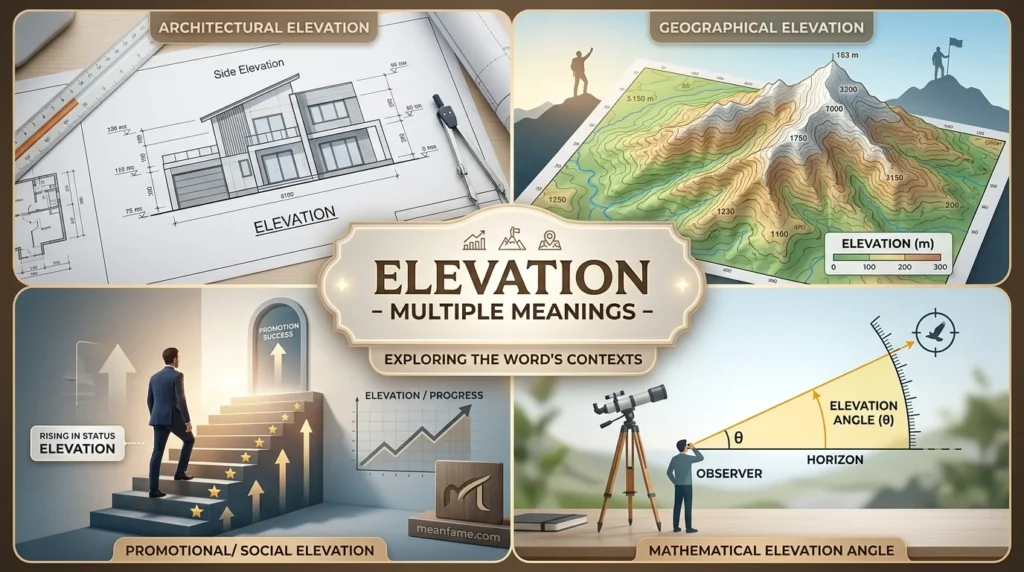

What Does “Elevation” Mean?
The primary elevation meaning is the height of something above a reference point or the act of raising something higher.
Quick Definition
Elevation = The height of a place or object above sea level or another reference point, or the act of lifting or raising something.
What It Usually Means in Everyday Conversations
When someone says:
“Denver has a high elevation.”
They usually mean:
“Denver is located high above sea level.”
Another example:
“Keep your foot elevated.”
Meaning:
“Raise your foot to help reduce swelling.”
What Tone Does It Convey?
Depending on the context, elevation is generally:
- Neutral
- Informative
- Professional
- Technical
- Inspirational (when used figuratively)
What Does Elevation Mean in Different Contexts?
Geography
In geography, elevation is the height of land above mean sea level.
Example:
“The mountain has an elevation of 8,000 feet.”
Architecture
Architects use elevation to describe a flat drawing that shows one side of a building.
Examples:
- Front elevation
- Side elevation
- Rear elevation
Medicine
Doctors often recommend elevation as part of injury treatment.
Example:
“Keep your ankle elevated to reduce swelling.”
Engineering and Construction
Engineers use elevation measurements when planning roads, bridges, buildings, and drainage systems.
Aviation
Pilots monitor elevation and altitude to ensure safe flight operations, especially during takeoff and landing.
Everyday English
People also use elevation figuratively.
Example:
“His promotion marked an elevation in status.”
Meaning:
An increase in rank or importance.
Origin and History of Elevation
The word elevation comes from the Latin verb elevare, meaning to raise up or lift. It entered English through French and has been used for centuries to describe physical height as well as the act of raising something.
Over time, its meaning expanded beyond physical height to include architecture, medicine, engineering, and figurative ideas such as promotions, honor, and improvement.
Today, elevation remains a widely used word in both technical and everyday language.
How People Actually Use Elevation
People commonly use elevation in these situations:
- Reading maps
- Hiking and mountain climbing
- Weather forecasts
- Building design
- Injury recovery
- Construction projects
- Describing promotions or achievements
Common expressions include:
- High elevation
- Sea-level elevation
- Front elevation
- Gain elevation
- Elevation map
- Elevation drawing
When to Use It
Use elevation when referring to:
- Height above sea level.
- Raising an injured limb.
- Architectural drawings.
- Increased status or position.
When Not to Use It
Avoid using elevation when a simpler word like “height” or “lift” is more natural for everyday conversations.
Real Examples of Elevation in Conversations
Example 1
Person A: Why is it colder here?
Person B: We’re at a much higher elevation.
Meaning: Higher above sea level.
Why it was used: Geography.
Example 2
Person A: My ankle hurts.
Person B: Keep it elevated.
Meaning: Raise it above heart level.
Example 3
Person A: Which drawing shows the front of the house?
Person B: The front elevation.
Meaning: Architectural view.
Example 4
Person A: How tall is the mountain?
Person B: Its elevation is over 10,000 feet.
Meaning: Height above sea level.
Example 5
Person A: Why are hikers tired?
Person B: The high elevation has less oxygen.
Meaning: Mountain altitude.
Example 6
Person A: He got promoted.
Person B: That’s quite an elevation in his career.
Meaning: Higher position.
Example 7
Person A: What’s on this map?
Person B: It shows elevation changes.
Meaning: Differences in land height.
Example 8
Person A: Why did the doctor recommend pillows?
Person B: For leg elevation.
Meaning: Reduce swelling.
Example 9
Person A: Which side of the building is this?
Person B: The rear elevation.
Meaning: Architectural drawing.
Example 10
Person A: The road climbs quickly.
Person B: You’ll gain a lot of elevation.
Meaning: Increase in height.
Common Mistakes and Misunderstandings
Mistake 1
Confusing elevation with altitude.
Elevation refers to the height of a fixed point on Earth’s surface, while altitude usually refers to the height of an object above the ground or sea level, such as an airplane.
Mistake 2
Thinking elevation only refers to mountains.
It also applies to buildings, maps, medicine, engineering, and figurative situations.
Mistake 3
Using elevation instead of height in casual conversations.
While both can be correct, “height” is often simpler for everyday use.
Mistake 4
Assuming architectural elevation means physical height.
In architecture, an elevation is usually a drawing of one side of a structure.
Similar Words and Related Terms
| Word | Meaning | Difference |
|---|---|---|
| Height | Vertical measurement | More general than elevation |
| Altitude | Height above sea level or ground | Often used for aircraft |
| Rise | Upward movement | Focuses on movement |
| Lift | Raise something | Action rather than measurement |
| Ascent | Climb upward | Refers to movement |
| Level | Relative height | Measurement reference |
| Summit | Highest point | Top of a mountain |
| Promotion | Advancement in rank | Figurative elevation |
| Uplift | Raise emotionally or physically | Broader meaning |
| Increase | Become greater | Doesn’t always involve height |
Internal linking opportunities: altitude meaning, height meaning, summit meaning, promotion meaning, uplift meaning.
Is Elevation Positive, Negative, or Neutral?
Elevation is generally a neutral word.
Positive examples:
- Career elevation
- Spiritual elevation
- Elevated position
Neutral examples:
- Elevation map
- Elevation measurement
- Building elevation
Negative meanings are uncommon and depend entirely on context.
Should You Use Elevation?
Yes. Elevation is the correct word when discussing height above sea level, architectural drawings, medical care, engineering, or figurative increases in status.
Use it if:
- You’re describing mountains or landscapes.
- You’re reading maps.
- You’re discussing architecture.
- You’re explaining injury treatment.
- You’re referring to promotions or advancement.
Avoid it if:
- A simpler word like “height” better suits your audience.
- The context doesn’t involve height or raising something.