
What Does “Carat” Mean?
Quick Definition
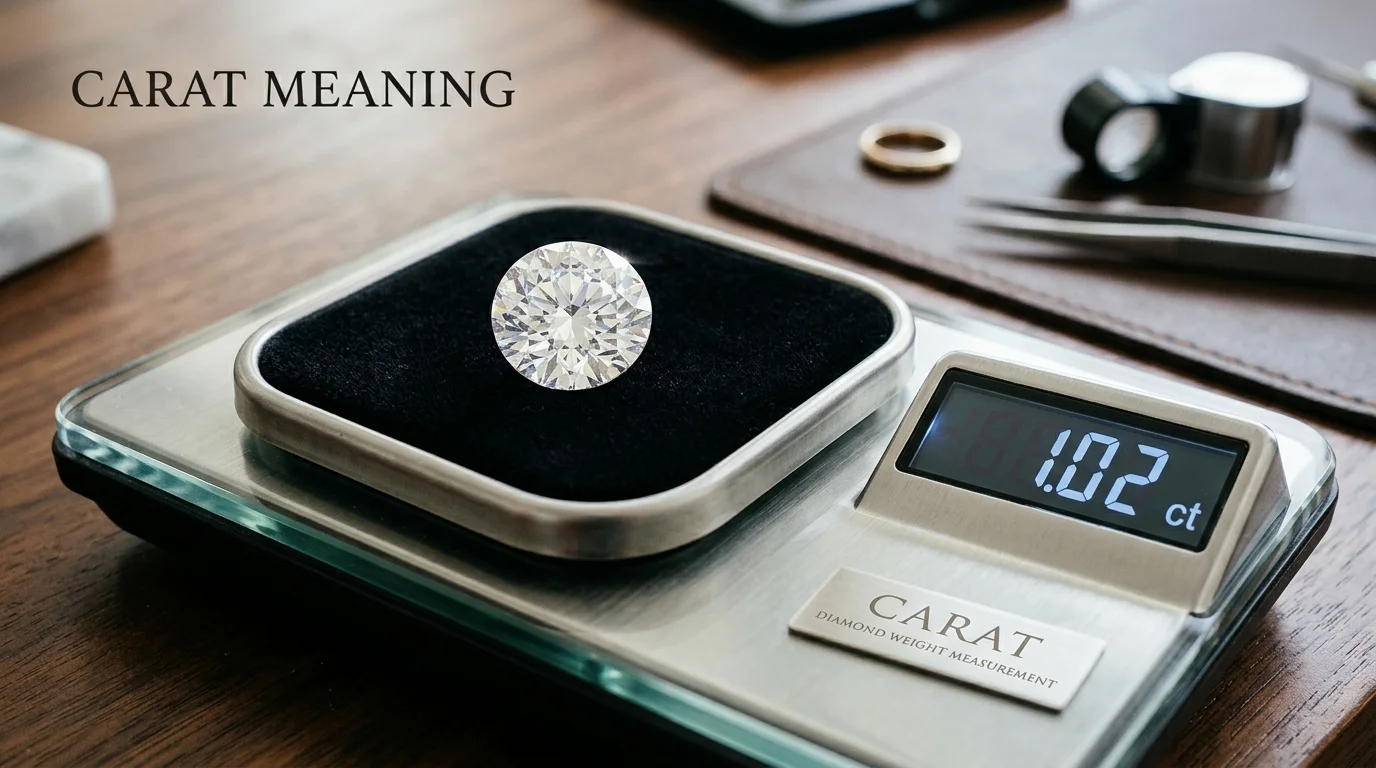
A carat is a standard unit of weight used for diamonds, gemstones, and pearls.
What It Usually Means in Jewelry
When jewelers refer to carats, they are talking about how much a gemstone weighs.
Literal Meaning
One carat equals:
- 200 milligrams
- 0.2 grams
- 0.00705 ounces
Most Common Interpretation
Most consumers associate carat with diamond size, but technically it measures weight rather than physical dimensions.
What Tone Does It Convey?
The term is generally associated with:
- Luxury
- Jewelry
- Diamonds
- Gemstones
- Value
What Does Carat Mean in Different Contexts?
Diamonds
Carat weight is one of the famous “4 Cs” used to evaluate diamonds:
- Carat
- Cut
- Color
- Clarity
Colored Gemstones
Rubies, sapphires, emeralds, and other gemstones are also measured in carats.
Pearls
Some pearls may be described using carat weight measurements, although pearl sizing is often discussed in millimeters.
Jewelry Shopping
Consumers often compare carat weights when choosing rings, necklaces, earrings, and bracelets.
Investment Gems
Carat weight plays a major role in determining the value of rare investment-grade gemstones.
Origin and History of Carat
The word carat comes from the ancient carob seed.
Historically, traders used carob seeds as a reference for weighing gemstones because the seeds were believed to have relatively consistent weights.
The term eventually evolved through several languages before becoming the modern word “carat.”
To standardize gemstone trading worldwide, the metric carat was officially established.
Today:
1 metric carat = 200 milligrams
This international standard is used globally throughout the jewelry industry.
How Carat Weight Works
Many buyers assume that doubling the carat weight simply doubles the value.
In reality, pricing often increases much faster because larger gemstones are rarer.
Common Carat Weights
Popular diamond sizes include:
- 0.25 carat
- 0.50 carat
- 0.75 carat
- 1.00 carat
- 1.50 carats
- 2.00 carats
- 3.00 carats
Carat Fractions
Jewelry professionals often describe diamonds using points.
Examples:
- 25 points = 0.25 carat
- 50 points = 0.50 carat
- 75 points = 0.75 carat
- 100 points = 1 carat
Why Two Diamonds Can Look Different
Even with identical carat weights:
- Cut quality may differ.
- Shape may differ.
- Depth may differ.
- Visual appearance may differ.
Real Examples of Carat in Everyday Situations
Example 1
Customer: How large is the diamond?
Jeweler: It’s one carat.
Meaning: The diamond weighs 200 milligrams.
Why it was used: Standard gemstone measurement.
Example 2
Friend A: What size engagement ring did you get?
Friend B: A two-carat diamond.
Meaning: The diamond weighs 0.4 grams.
Why it was used: Describing gemstone weight.
Example 3
Buyer: Why is this diamond more expensive?
Seller: It has a higher carat weight.
Meaning: Larger weight contributes to value.
Why it was used: Pricing explanation.
Example 4
Jeweler: This sapphire weighs three carats.
Meaning: Gemstone weight measurement.
Why it was used: Product description.
Example 5
Collector: I prefer gemstones over five carats.
Meaning: Preference for larger stones.
Why it was used: Collection criteria.
Example 6
Investor: Larger diamonds are rarer.
Meaning: Higher carat weights often increase rarity.
Why it was used: Market discussion.
Example 7
Shopper: Is one carat considered large?
Jeweler: It’s one of the most popular sizes.
Meaning: Common consumer preference.
Why it was used: Buying advice.
Example 8
Friend: Her ring looks huge.
Response: It’s a two-carat oval diamond.
Meaning: Significant gemstone weight.
Why it was used: Visual comparison.
Example 9
Customer: What’s the difference between these stones?
Jeweler: Mainly carat weight.
Meaning: Weight distinction.
Why it was used: Product comparison.
Example 10
Buyer: Does higher carat always mean better?
Expert: Not necessarily.
Meaning: Other quality factors matter.
Why it was used: Education.
Common Mistakes and Misunderstandings
Mistake 1: Thinking Carat Measures Size
Carat measures weight, not physical dimensions.
Mistake 2: Assuming Bigger Means Better
Cut, color, and clarity can be just as important as carat weight.
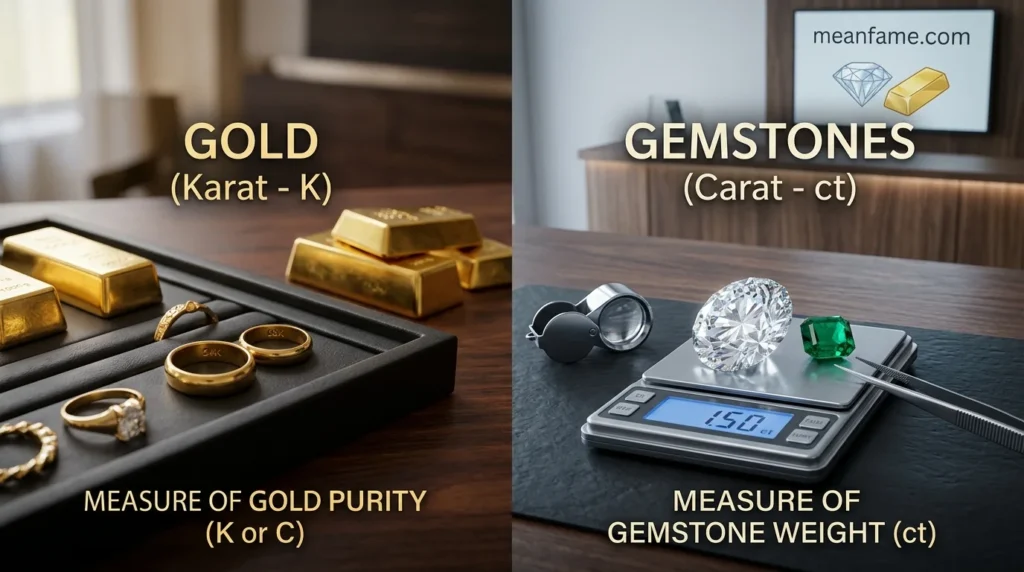
Mistake 3: Confusing Carat and Karat
These terms are completely different.
Mistake 4: Believing Equal Carat Means Equal Appearance
Different shapes and cuts can make stones appear larger or smaller.
How to Avoid Confusion
Remember:
- Carat = gemstone weight.
- Karat = gold purity.
- Size and weight are not identical.
Similar Terms and Related Jewelry Concepts
| Term | Meaning | Difference |
|---|---|---|
| Carat | Gemstone weight | Measures diamonds and gems |
| Karat | Gold purity | Measures gold content |
| Cut | Gemstone proportions | Affects sparkle |
| Clarity | Internal imperfections | Quality factor |
| Color | Diamond color grade | Quality factor |
| Point | One-hundredth of a carat | Smaller unit |
| Gemstone | Precious or semi-precious stone | Broader category |
| Diamond | Specific gemstone | Often measured in carats |
| Setting | Jewelry mounting | Holds gemstone |
| Certification | Gem grading report | Verifies quality |
Is Carat Positive, Negative, or Neutral?
The term carat is generally neutral.
Positive Associations
- Luxury jewelry
- Diamonds
- Engagement rings
- Valuable gemstones
Neutral Associations
- Measurement standards
- Gemstone grading
- Jewelry evaluation
Negative Associations
The term itself has no negative meaning, although buyers may associate higher carat weights with increased costs.
Should You Pay Attention to Carat Weight?
Yes, If
- You’re buying a diamond.
- You’re comparing gemstones.
- You’re investing in jewelry.
- You care about rarity.
Don’t Focus Only on Carat If
- Sparkle matters more.
- Budget is limited.
- Cut quality is poor.
- Overall appearance is your priority.
A balanced approach often provides the best value.