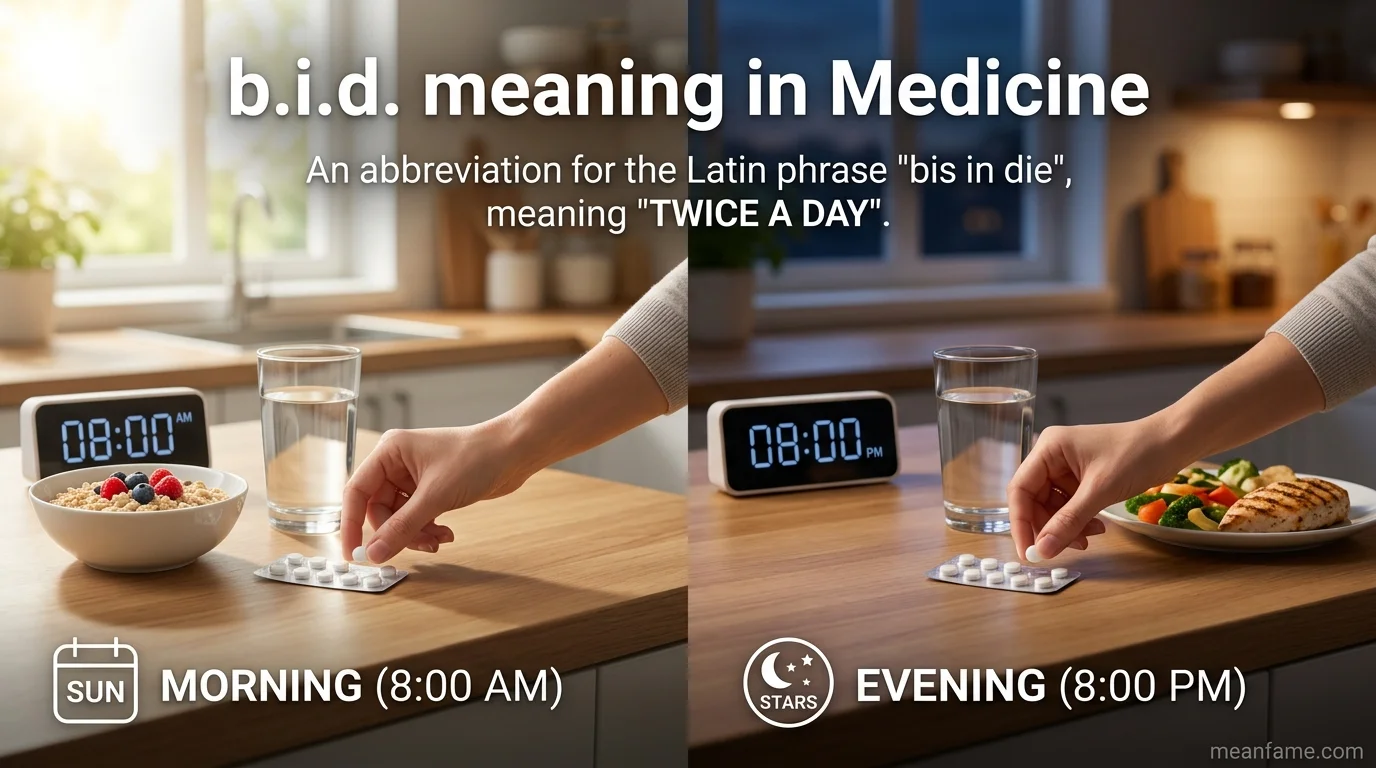
What Does “B.I.D.” Mean Medicine?
Quick Definition
B.I.D. means “twice a day.”
What It Usually Means on a Prescription
When a prescription says:
Take 1 tablet B.I.D.
It means:
Take one tablet two times each day.
Literal Meaning
The abbreviation comes from the Latin phrase:
Bis in die
Which translates to:
Twice daily or two times a day.
Most Common Interpretation
Healthcare providers use B.I.D. to instruct patients to take a medication twice every day, generally with doses spread evenly throughout the day.
What Tone Does It Convey?
The abbreviation conveys:
- Prescription instructions
- Medical guidance
- Dosage frequency
- Professional healthcare communication
What Does B.I.D. Mean in Different Medical Settings?
Prescriptions
Doctors may write:
Amoxicillin 500 mg B.I.D.
Meaning:
Take 500 mg twice daily.
Pharmacy Labels
Pharmacists often replace B.I.D. with the clearer wording:
Take twice daily.
This helps reduce confusion.
Hospitals
Healthcare staff may still use B.I.D. in medical charts and treatment plans.
Electronic Health Records
Many hospitals now use plain-language instructions instead of Latin abbreviations to improve patient safety.
Origin and History of B.I.D.
B.I.D. comes from the Latin phrase bis in die, meaning “twice in a day.”
For centuries, Latin was the standard language of medicine, science, and pharmacy. As a result, many prescription abbreviations originated from Latin. Today, while healthcare professionals still recognize B.I.D., many hospitals and pharmacies prefer writing “twice daily” in full to reduce medication errors.
How People Actually Use B.I.D.
Meaning 1: Prescription Frequency
Example:
“Take one capsule B.I.D.”
Meaning:
Take one capsule twice each day.
Meaning 2: Medical Chart
Example:
“Medication: B.I.D.”
Meaning:
Administer the medicine two times daily.
Meaning 3: Pharmacy Instructions
Example:
“The label says B.I.D.”
Meaning:
Follow a twice-daily dosing schedule.
When Healthcare Professionals Use It
You’ll commonly see B.I.D. in:
- Prescriptions
- Hospital charts
- Medication records
- Pharmacy documentation
- Clinical notes
Real Examples of B.I.D. in Conversations
Example 1
Patient: What does B.I.D. mean?
Pharmacist: It means take your medicine twice a day.
Meaning: Prescription explanation.
Why it was used: Patient education.
Example 2
Doctor: Take this antibiotic B.I.D. for seven days.
Meaning: Two doses daily.
Why it was used: Treatment instructions.
Example 3
Nurse: The medication is scheduled B.I.D.
Meaning: Twice-daily administration.
Why it was used: Hospital care.
Example 4
Patient: Should I take it morning and evening?
Doctor: Yes, unless your prescription says otherwise.
Meaning: Evenly spaced doses.
Why it was used: Clarification.
Example 5
Pharmacist: Follow the label exactly.
Meaning: Proper medication use.
Why it was used: Safety advice.
Example 6
Medical Student: B.I.D. comes from Latin.
Professor: Correct—bis in die.
Meaning: Medical terminology.
Why it was used: Education.
Example 7
Caregiver: The chart says B.I.D.
Nurse: Give the medicine twice today.
Meaning: Dosage schedule.
Why it was used: Patient care.
Example 8
Patient: Can I take both doses together?
Doctor: No. Space them out unless specifically instructed otherwise.
Meaning: Safe medication practice.
Why it was used: Medical guidance.
Example 9
Friend: My prescription says B.I.D.
Response: That means twice a day.
Meaning: Everyday explanation.
Why it was used: Casual conversation.
Example 10
Doctor: Always follow your prescribed schedule.
Meaning: Correct medication timing.
Why it was used: Healthcare advice.
Common Mistakes and Misunderstandings
Mistake 1: Thinking B.I.D. Means Every 12 Hours Exactly
Although doses are often spaced about 12 hours apart, you should always follow your healthcare provider’s specific instructions.
Mistake 2: Taking Both Doses at the Same Time
Unless instructed otherwise, the doses should be taken separately.
Mistake 3: Confusing B.I.D. with T.I.D.
B.I.D. means twice daily.
T.I.D. means three times daily.
Mistake 4: Guessing Prescription Abbreviations
If you’re unsure about any abbreviation, ask your doctor or pharmacist rather than guessing.
Similar Medical Abbreviations
| Abbreviation | Meaning | Frequency |
|---|---|---|
| B.I.D. | Twice daily | 2 times a day |
| Q.D. | Once daily | 1 time a day |
| T.I.D. | Three times daily | 3 times a day |
| Q.I.D. | Four times daily | 4 times a day |
| P.R.N. | As needed | When necessary |
| H.S. | At bedtime | Once nightly |
| A.C. | Before meals | Meal timing |
| P.C. | After meals | Meal timing |
| STAT | Immediately | Urgent |
| Q4H | Every 4 hours | Time interval |
Is B.I.D. Positive, Negative, or Neutral?
The B.I.D. meaning in medicine is completely neutral.
It is simply a standardized medical abbreviation that tells patients how often to take a medication.
Should You Use the Abbreviation B.I.D.?
Use It If
- You’re a healthcare professional.
- You’re reading medical records.
- You’re discussing prescription terminology.
- You’re studying medicine or pharmacy.
Avoid It If
- You’re giving medication instructions to someone unfamiliar with medical abbreviations. Writing “twice daily” is usually clearer.