

What Does “Simp” Mean in Slang?
Quick Definition
Simp is slang for a person, usually a man, who is excessively devoted to or submissive toward someone they’re romantically interested in, often to the point of degrading themselves, and typically without receiving equal attention or affection in return . The term is almost always uncomplimentary.
What It Usually Means In Conversations
When people use the word simp in everyday conversation, they’re usually referring to one of these things:
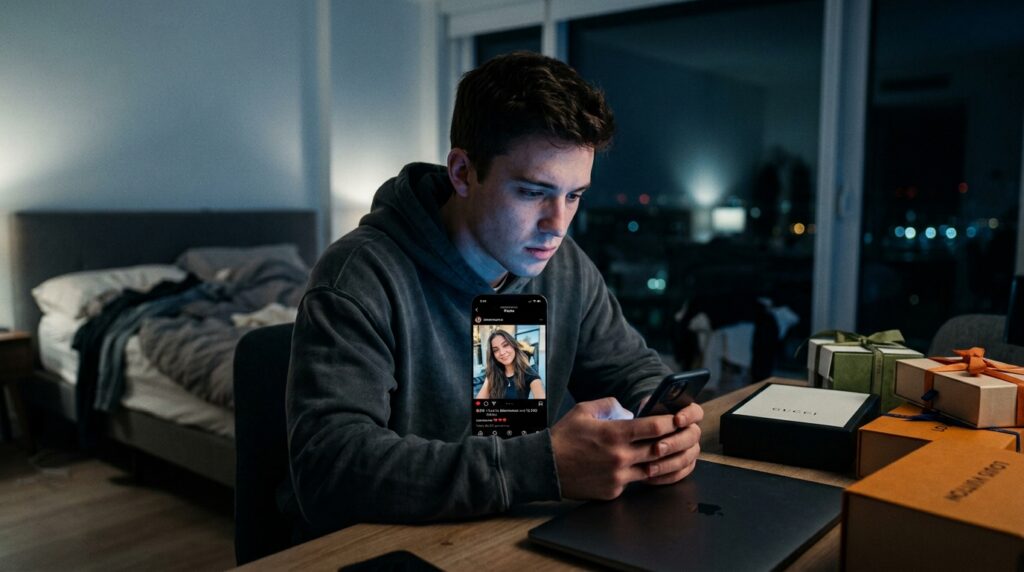
The noun meaning: A person (usually a man) who goes above and beyond for their crush or partner, often in a way that seems desperate or pathetic . A classic example is someone buying expensive gifts for a person who doesn’t even like them back.
The verb meaning: The act of simping—known as “simping” or “simping for” someone. For example, “He’s been simping for her all week” means he’s been going out of his way to impress or please her .
The common denominator: The key element of the simp meaning in slang is that the attention is unbalanced—the giver is doing way too much, and the receiver isn’t reciprocating .
What Tone Does It Convey?
The tone of simp depends heavily on the context:
| Context | Tone | Example |
|---|---|---|
| Among close friends | Playful, teasing | “Bro, you bought her coffee again? You’re such a simp” |
| Online arguments | Insulting, derogatory | “You’re just simping for her because she’s hot” |
| Social media comments | Snarky, critical | “This is peak simp behavior” |
| Fan communities | Affectionate, ironic | “I’m a simp for that actor” |
| Men’s rights forums | Hostile, misogynistic | Used to attack men who respect women |
What Does Simp Mean on Different Platforms?
TikTok
TikTok is where simp truly exploded in popularity. The platform saw a viral trend called “Simp Nation” starting in December 2019, where users would post videos describing stereotypical simp behaviors . Today, the simp meaning in slang on TikTok ranges from humorous teasing to genuine criticism.
Example: “POV: You’re simping for someone who doesn’t even know you exist.”
Twitch
On Twitch, simp often refers to viewers who donate large amounts of money to female streamers in hopes of getting noticed, or who defend streamers obsessively in chat . It’s also used when viewers are accused of being overly devoted to a streamer.
Example: “He donated $500 just for a shoutout. Total simp.”
Instagram is full of simp content—memes, comments, and posts calling out simp behavior. The hashtag #simp has hundreds of thousands of posts . The simp meaning in slang on Instagram is often used humorously in comment sections.
Example: “He liked every single one of her photos. Simp behavior.”
Reddit has extensive discussions about simp across various subreddits. The term was heavily used in men’s rights and anti-feminist forums before going mainstream . Some subreddits use it critically to discuss toxic relationship dynamics.
Example: “Is it simp behavior to always pay for your girlfriend’s meals?”
Discord
In Discord servers, especially gaming communities, simp is used to tease friends who go out of their way for a crush or who defend someone obsessively.
Example: “He left our game just to talk to her. That’s a simp move.”
YouTube
YouTube comments are full of simp accusations, often directed at creators who show appreciation toward women. Fan communities also use it affectionately—”I simp for this YouTuber” .
Example: “The comments are full of simps.”
Dating Apps
On dating apps, some people list “don’t be a simp” in their bios, while others use it self-deprecatingly. The simp meaning in slang on dating apps is often about balancing effort with self-respect.
Example: “Looking for someone who won’t treat me like a simp.”
Origin and History of Simp
The simp meaning in slang has a surprisingly long history. Here’s how the term evolved:
Early 1900s: Simpleton
Simp originally came from “simpleton,” meaning a foolish or naive person. The first recorded use in this sense was in The New York Times in 1923 . It was a fairly mild insult—someone who was a bit simple or silly.
1980s: Hip-Hop Adoption
The modern simp meaning in slang emerged in the 1980s when West Coast rappers like Too Short and Hugh E.M.C. started using it to describe men who were “soft” or overly sympathetic to women . Too Short described a simp as “the opposite of a pimp” .
1990s: Mainstream Music
The term appeared in several popular songs: Sir Mix-a-Lot’s “Baby Got Back” (1992) with the lyric “a lot of simps won’t like this song,” Boyz II Men’s “Sympin’ Ain’t Easy” (1992), and Three 6 Mafia’s “Sippin’ on Some Syrup” (1999) .
2000s: Online Communities
Simp started appearing on Urban Dictionary in 2003. It was later picked up by men’s rights forums, where it was used to criticize men who were seen as too respectful toward women .
2019–2020: TikTok Explosion
Simp went mainstream thanks to TikTok. The “Simp Nation” trend, started by TikTok user @pollo.boyy, brought the term to a massive audience . It’s now one of the most recognized internet slang terms.
2026: Cultural Significance
Today, the simp meaning in slang is widely recognized and used across all social media platforms. It has been debated by linguists and criticized for its ties to toxic masculinity .
How People Actually Use Simp
When to Use It
Use it when:
Teasing a friend who’s going overboard for their crush
Calling out behavior that seems desperate or one-sided
Describing someone who does way too much for someone who doesn’t care
In fan communities, as an ironic or affectionate term
**The simp meaning in slang is most effective when used lightheartedly among friends who understand the joke .
When Not to Use It
Avoid it when:
You could genuinely hurt someone’s feelings
You’re in a professional or formal setting
You’re using it to attack someone for being kind or respectful
You’re not sure if the other person knows the term (they might take it literally)
Real Examples of Simp in Conversations
Example 1: Teasing a Friend
Person A: “I waited outside her class for an hour just to give her a coffee.”
Person B: “Bro, you’re simping so hard. She doesn’t even like coffee.”
Meaning: Person B is teasing Person A for going overboard.
Why it was used: Playful ribbing among friends .
Example 2: Online Commentary
Person A: “He sent her $200 for her birthday and she didn’t even say thank you.”
Person B: “That’s simp behavior. He needs to stop.”
Meaning: Person B is calling out a one-sided relationship.
Why it was used: Critical observation of unbalanced effort.
Example 3: Verb Form
Person A: “Did you see Jake’s Instagram story? He’s been simping for her all week.”
Person B: “I know. It’s getting embarrassing.”
Meaning: Person A is using simp as a verb to describe ongoing behavior.
Why it was used: To describe a pattern of excessive attention .
Example 4: Defensive Behavior
Person A: “She’s not that great, man. She’s rude to everyone.”
Person B: “Stop simping. You don’t need to defend her.”
Meaning: Person B is accusing Person A of blind devotion.
Why it was used: To call out someone for defending bad behavior.
Example 5: Fan Community
Person A: “I’m a huge simp for that actor.”
Person B: “Honestly, same. Did you see their new movie?”
Meaning: Affectionate use of simp to describe being a fan.
Why it was used: Ironic, self-aware fandom .
Example 6: Social Media Callout
Person A: “He liked every post she’s ever made in one night.”
Person B: “What a simp. Does she even follow him back?”
Meaning: Calling out excessive social media attention.
Why it was used: To criticize desperate online behavior.
Example 7: Gaming Context
Person A: “He keeps going back to revive her even though she’s terrible.”
Person B: “Bro, stop simping. She’s gonna get us killed.”
Meaning: Person B is accusing Person A of prioritizing someone over the team.
Why it was used: Gaming-specific callout of simping behavior.
Example 8: Relationship Advice
Person A: “She only texts me when she needs a ride.”
Person B: “That’s not a relationship. You’re simping for her.”
Meaning: Pointing out a one-sided dynamic.
Why it was used: To encourage self-respect.
Example 9: Self-Awareness
Person A: “I know I’m simping, but I don’t even care at this point.”
Person B: “At least you’re aware. That’s the first step.”
Meaning: Self-deprecating acknowledgment of behavior.
Why it was used: To use the term humorously about oneself.
Example 10: Workplace Misunderstanding
Person A: “I stayed late to help Lisa with her project.”
Person B: “Simp.”
Person A: “It’s called being a good colleague.”
Meaning: Misuse of simp in a professional context.
Why it was used: Inappropriately applied to workplace behavior.
Common Mistakes and Misunderstandings
Confusing “Simp” with Being Nice
Not every kind act is simping. A nice person treats others with respect and kindness in a balanced way. A simp, in the slang sense, goes far beyond that—they prioritize the other person’s every wish above their own needs and self-respect, usually with little or nothing in return .
Thinking It’s Always an Insult
While the simp meaning in slang is generally negative, among close friends it’s often used as a lighthearted joke. The tone depends heavily on who is saying it and how .
Assuming It’s Only About Men
While simp is most commonly applied to men, the behavior isn’t limited to any gender. Women can be simps too .
Believing It’s a New Term
The simp meaning in slang has been around for decades, not just since TikTok. It originated in hip-hop culture in the 1980s .
Using It Formally
Simp is casual slang. It’s not appropriate for professional settings, academic writing, or formal conversations.
Confusing It with Other Terms
Simp is different from “white knight” (someone who defends women online), “orbiter” (someone who hovers around a crush without making a move), or “nice guy” (someone who acts nice expecting sex in return), though there is overlap .
Similar Slang Terms and Related Words
| Term | Meaning | Difference from Simp |
|---|---|---|
| White knight | Someone who defends women online, especially against criticism | Focuses on defense and protection, not necessarily excessive devotion |
| Orbiter | Someone who stays around a crush without making a move, hoping for a chance | Focuses on hovering and waiting, not actively doing too much |
| Nice guy | Someone who acts nice expecting romantic or sexual favors in return | Often implies manipulation; simp implies desperation without expectations |
| Stan | An obsessive fan of a celebrity | Used affectionately and not gender-specific |
| Cuck | Someone who is weak or submissive | More degrading and politically charged; simp is lighter |
| Beta | A submissive, weak man | Broader term about masculinity; simp is specifically about romantic devotion |
| Pimp | Someone who controls sex workers | The opposite of a simp in the original hip-hop context |
Is “Simp” Positive, Negative, or Neutral?
The simp meaning in slang is generally negative, but it depends on context:
Negative Simp:
Used to genuinely insult someone’s lack of self-respect
Implying someone is desperate or pathetic
Used to criticize men for being kind or respectful (problematic)
Playful/Neutral Simp:
Teasing friends about harmless behavior
Self-deprecating humor
Ironic use in fan communities
Problematic Use:
Critics argue the term unfairly shames men for being kind or caring
It can imply that women are manipulative and that showing emotion is weakness
It’s been used by misogynistic communities to attack respectful men
Should You Use “Simp”?
You might use it if:
You’re joking around with friends who understand the term
You’re describing genuinely excessive, one-sided behavior
You’re in a fan community where it’s used affectionately
You should avoid it if:
You could genuinely hurt someone’s feelings
You’re in a professional or formal setting
You’re using it to attack someone for being kind or respectful
You don’t know the person well enough to joke with them