

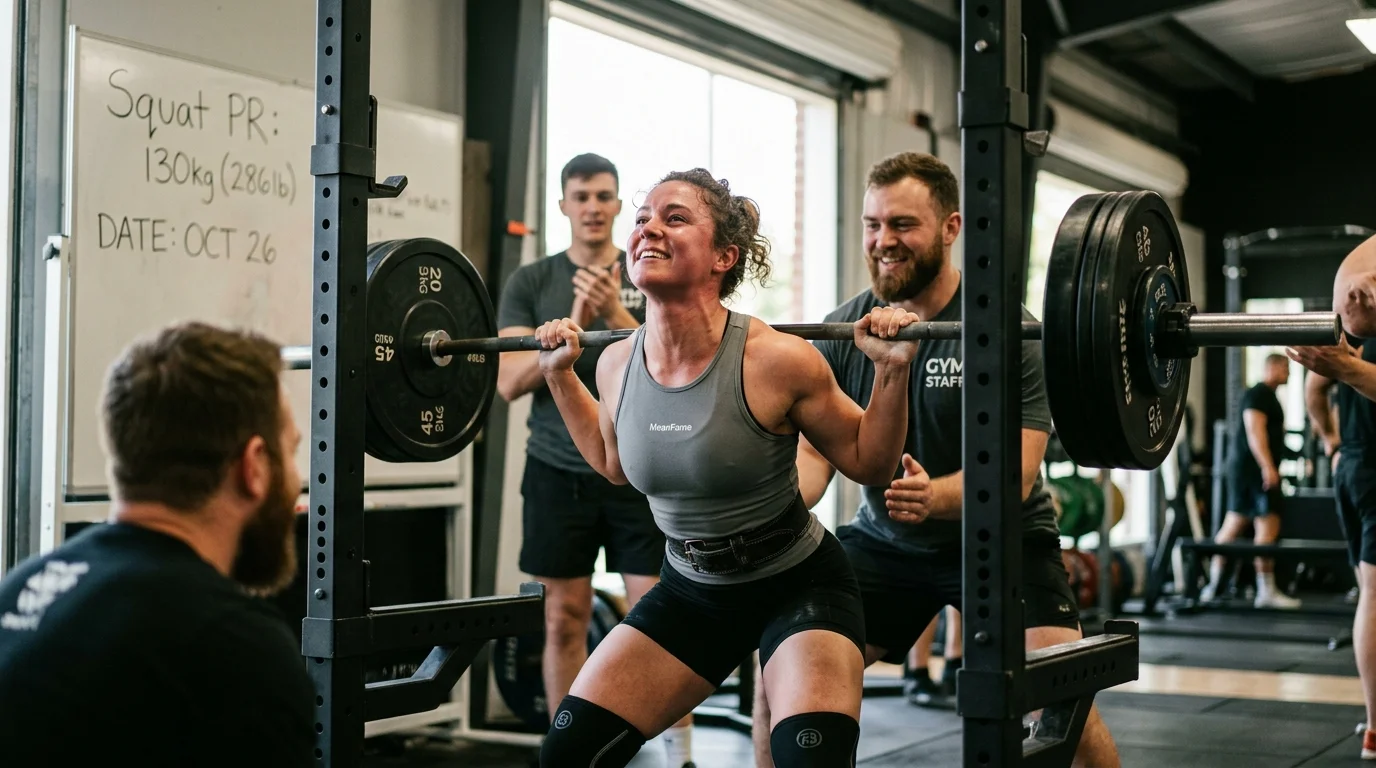
What Does “PR” Mean in Workout?
The primary PR meaning in workout is:
Personal Record
A PR represents your highest achievement in a specific exercise or fitness activity.
Quick Definition
PR = The best result you’ve personally achieved in a workout, exercise, lift, run, or athletic performance.
What It Usually Means in Fitness
When someone says:
“I hit a new PR today!”
They mean:
“I achieved my best performance ever.”
Examples include:
- Heaviest bench press
- Fastest mile run
- Most pull-ups completed
- Best deadlift
- Fastest workout time
What Tone Does It Convey?
PR is usually associated with:
- Success
- Achievement
- Progress
- Motivation
- Celebration
PR Meaning in Different Fitness Activities
Weightlifting
In weightlifting, a PR often refers to the heaviest weight successfully lifted.
Example:
“My deadlift PR is 405 pounds.”
Powerlifting
Powerlifters track PRs for:
- Squat
- Bench Press
- Deadlift
Example:
“I set a new squat PR today.”
Running
Runners use PR to describe their fastest time.
Example:
“I ran a 5K PR this weekend.”
CrossFit
CrossFit athletes track PRs in:
- Weightlifting movements
- Workout completion times
- Repetition counts
Example:
“I got a new Fran PR.”
Bodyweight Training
PRs can also apply to:
- Pull-ups
- Push-ups
- Dips
- Planks
Example:
“My pull-up PR is 25 reps.”
Origin and History of PR in Fitness
The term Personal Record has been used in sports and athletics for many decades. Competitive athletes needed a way to measure improvement, so they began tracking their best performances.
Over time, gyms, running communities, CrossFit boxes, and sports organizations adopted the term. Today, PR is one of the most common fitness abbreviations worldwide.
How People Actually Use PR
1. Celebrating Progress
Example:
“Finally hit a bench press PR!”
Meaning:
A new personal best was achieved.
2. Tracking Goals
Example:
“My goal is to beat my 10K PR.”
Meaning:
Improve a previous best performance.
3. Social Media Fitness Posts
Example:
“New PR: 315-pound squat!”
Meaning:
Sharing a fitness achievement.
When to Use PR
Use PR when discussing:
- Personal fitness achievements
- Running times
- Strength records
- Workout improvements
When Not to Use PR
Avoid using PR if you’re referring to someone else’s record unless you clarify whose record it is.
Real Examples of PR in Conversations
Example 1
Person A: How was your workout?
Person B: I hit a deadlift PR.
Meaning: New personal best deadlift.
Example 2
Person A: Why are you celebrating?
Person B: I ran my fastest mile ever—a new PR.
Meaning: Personal record.
Example 3
Person A: What’s your bench press PR?
Person B: 225 pounds.
Meaning: Highest bench press completed.
Example 4
Person A: Did you finish the race?
Person B: Yes, and I got a PR.
Meaning: Fastest race time.
Example 5
Person A: How many pull-ups can you do?
Person B: My PR is 20.
Meaning: Highest number achieved.
Example 6
Person A: Why do athletes track PRs?
Person B: It helps measure progress.
Meaning: Fitness tracking.
Example 7
Person A: What happened at the gym?
Person B: New squat PR!
Meaning: Personal best squat.
Example 8
Person A: What’s your goal this month?
Person B: Break my 5K PR.
Meaning: Beat previous best time.
Example 9
Person A: Did you improve?
Person B: I set a PR by five seconds.
Meaning: Faster performance.
Example 10
Person A: Why are PRs important?
Person B: They show your progress over time.
Meaning: Fitness improvement measurement.
Common Mistakes and Misunderstandings
Mistake 1
Thinking PR only applies to weightlifting.
PRs can be used in running, swimming, cycling, CrossFit, and many other sports.
Mistake 2
Confusing PR with world records.
A PR is your personal best, not necessarily a competitive or global record.
Mistake 3
Comparing your PR to others.
PRs are primarily meant to track your own improvement.
Mistake 4
Assuming every workout should result in a PR.
Most training sessions focus on building consistency rather than breaking records.
Similar Fitness Terms
| Term | Meaning | Difference |
|---|---|---|
| PR | Personal Record | Personal best performance |
| PB | Personal Best | Often interchangeable with PR |
| 1RM | One Rep Max | Heaviest weight for one repetition |
| Max | Highest performance | Broader term |
| Benchmark | Standard performance measure | Used for comparison |
| Split | Time segment in a race | Running-related |
| Rep | Repetition | Single exercise movement |
| Set | Group of repetitions | Training structure |
| Volume | Total work performed | Training metric |
| Progression | Gradual improvement | Long-term development |
Internal linking opportunities: PB meaning fitness, 1RM meaning, rep meaning gym, set meaning workout, volume training meaning.
Is a PR Positive, Negative, or Neutral?
A PR is almost always viewed as positive.
It usually represents:
- Improvement
- Achievement
- Progress
- Hard work
- Success
Fitness communities often celebrate PRs as milestones.
Should You Track PRs?
Yes. Tracking PRs can help you:
- Stay motivated.
- Measure improvement.
- Set realistic goals.
- Monitor training effectiveness.
- Celebrate progress.
However, don’t focus solely on PRs. Consistency and proper recovery are equally important.