
What Does “Neap Tide” Mean?
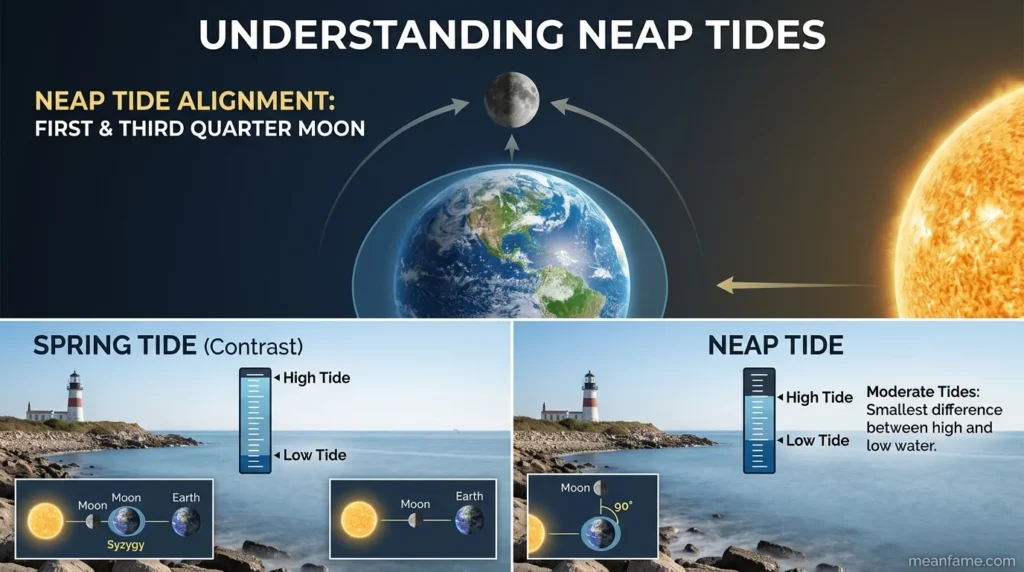
A neap tide is the period when the difference between high tide and low tide is at its smallest.
Quick Definition
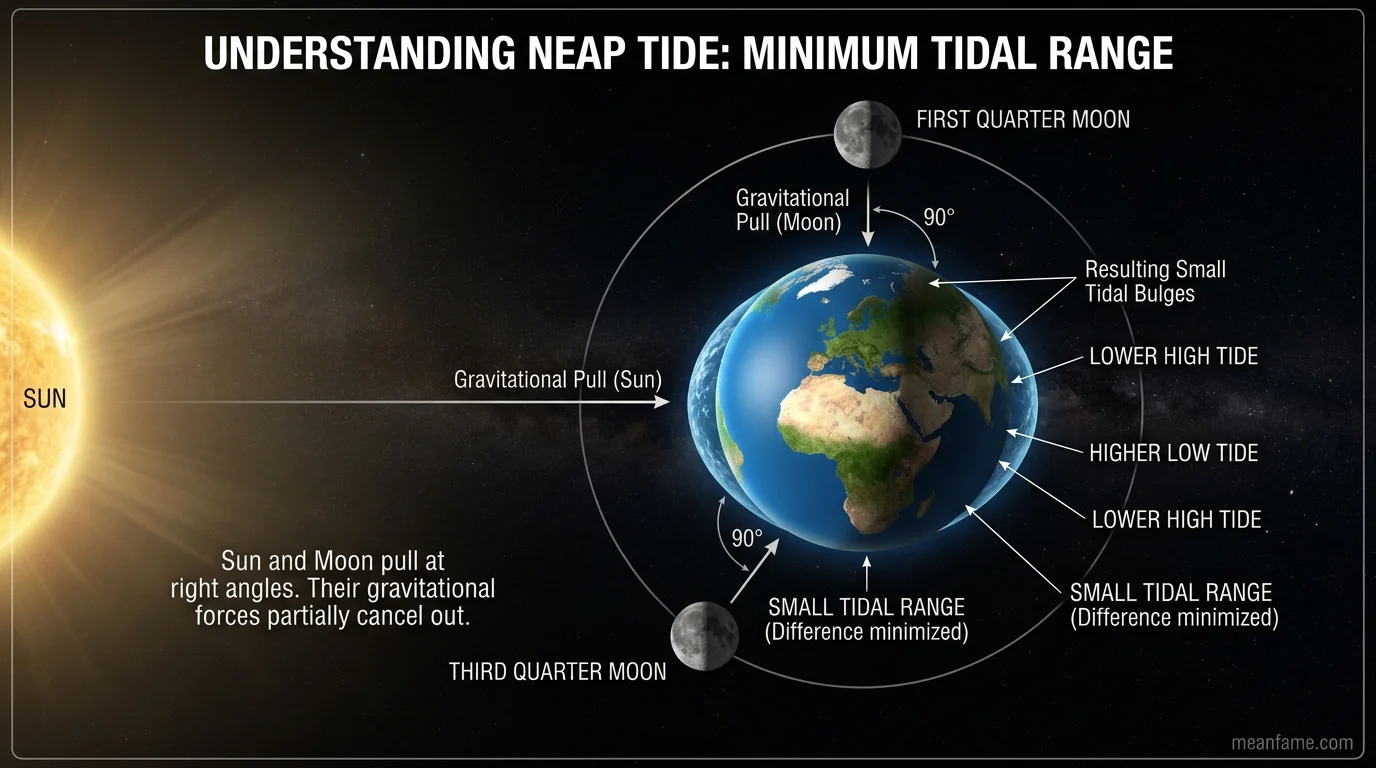
Neap Tide: A tide with the least tidal range, caused when the Sun’s and Moon’s gravitational pulls work at right angles to each other.
Literal Meaning
The word “neap” comes from an old English word meaning “scarce” or “lacking,” reflecting the reduced tidal range during this phase.
Scientific Meaning
During a neap tide:
- High tides are lower than normal.
- Low tides are higher than normal.
- The rise and fall of the ocean are less noticeable.
What Causes a Neap Tide?
Neap tides occur because both the Moon and the Sun exert gravitational forces on Earth’s oceans.
When the Moon is in its first quarter or third (last) quarter phase, the Sun and Moon form roughly a 90-degree angle with Earth.
Because their gravitational pulls act in different directions, they partially cancel each other out. As a result, the tidal range becomes smaller.
When Do Neap Tides Occur?
Neap tides happen twice during each lunar month.
They occur during:
- 🌗 First Quarter Moon
- 🌘 Third (Last) Quarter Moon
This means a neap tide usually occurs about one week after a spring tide and about one week before the next spring tide.
Characteristics of a Neap Tide
A neap tide has several distinctive features:
- Smaller difference between high and low tide
- Lower-than-normal high tides
- Higher-than-normal low tides
- Weaker tidal currents
- Less dramatic water movement
- Regular occurrence during each lunar cycle
Why Are Neap Tides Important?
Although neap tides are less noticeable, they have significant effects on both nature and human activities.
Marine Life
Many marine organisms adapt their feeding, breeding, and movement patterns to changing tides.
Navigation
Boaters and ship operators often consider neap tides when planning travel in shallow coastal waters.
Fishing
Some fishing conditions change during neap tides because water movement and currents are weaker.
Coastal Activities
People involved in kayaking, paddleboarding, or beach exploration may notice calmer tidal conditions during neap tides.
Real-Life Examples of Neap Tides
Example 1
A harbor experiences only a small change in water level throughout the day.
Meaning: A neap tide may be occurring.
Example 2
Beachgoers notice that the ocean doesn’t move very far up or down the shore.
Meaning: The tidal range is reduced.
Example 3
A fisherman observes weaker tidal currents than usual.
Meaning: Conditions are consistent with a neap tide.
Example 4
A sailing instructor explains why today’s tides are less extreme than last week’s.
Meaning: The lunar cycle has moved from a spring tide to a neap tide.
Example 5
Students learn that quarter moons produce smaller tides.
Meaning: They’re studying neap tides.
Neap Tide vs. Spring Tide
| Feature | Neap Tide | Spring Tide |
|---|---|---|
| Tidal Range | Smallest | Largest |
| High Tide | Lower | Higher |
| Low Tide | Higher | Lower |
| Moon Phase | First & Third Quarter | New & Full Moon |
| Sun-Moon Position | Right angle | Nearly aligned |
| Water Movement | Weaker | Stronger |
Common Misunderstandings
Myth: Neap tides happen in spring.
Reality: The name “spring tide” refers to water “springing” or rising strongly, not the spring season. Likewise, neap tides occur year-round.
Myth: Neap tides stop ocean movement.
Reality: Tides still occur during a neap tide, but the difference between high and low water is smaller.
Myth: Neap tides only affect oceans.
Reality: They also influence bays, estuaries, rivers connected to the sea, and coastal ecosystems.
Myth: Neap tides are rare.
Reality: They occur regularly twice every lunar month.
Related Ocean Terms
| Term | Meaning | Difference |
| Spring Tide | Largest tidal range | Opposite of a neap tide |
| High Tide | Highest water level | Occurs every tidal cycle |
| Low Tide | Lowest water level | Opposite of high tide |
| Tidal Range | Difference between high and low tide | Measurement of tide size |
| Lunar Cycle | Moon’s monthly phases | Controls tidal patterns |
| Gravity | Attractive force | Causes tides |
| Estuary | River meets the sea | Influenced by tides |
| Current | Moving water | Can strengthen or weaken with tides |
| Ocean Basin | Large body of seawater | Experiences tides worldwide |
| Coastline | Land next to the sea | Affected by changing tides |
Is a Neap Tide Good or Bad?
A neap tide is neither good nor bad. It’s simply a natural part of Earth’s tidal cycle.
Depending on the activity, it may be beneficial:
- Calmer conditions for some boating activities
- Reduced tidal currents
- Easier shoreline access in some locations
In other situations, stronger spring tides may be preferred, such as for certain types of fishing or navigation.