
What Does “Centerfold” Mean?
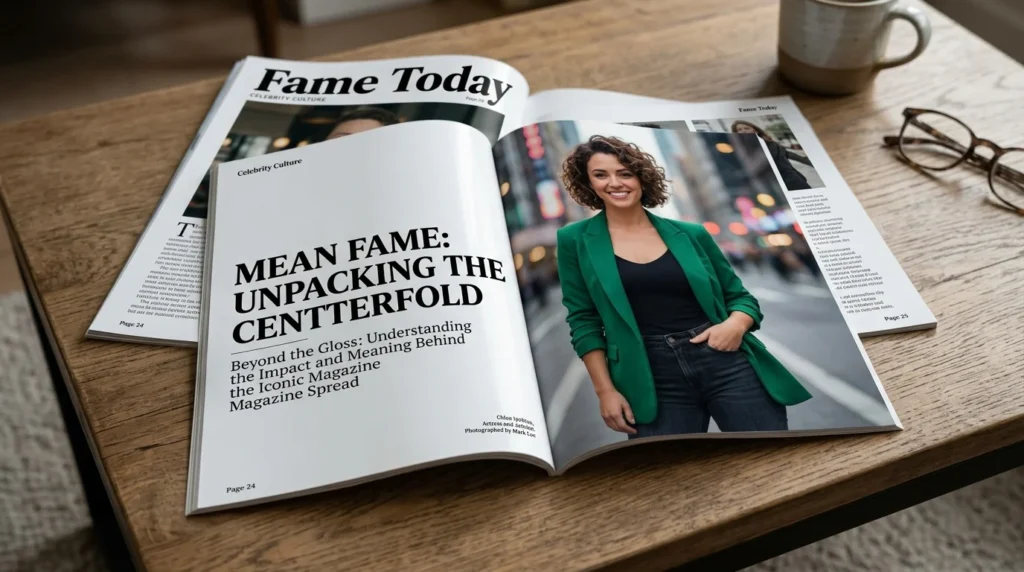
The most common centerfold meaning is a large image printed across the middle pages of a magazine.
Quick Definition
Centerfold (noun): A photograph, illustration, or poster printed on the two facing center pages of a magazine, sometimes designed to fold out for a larger display.
Literal Meaning
The word combines:
- Center = the middle of something.
- Fold = where the pages of a magazine are bound together.
Together, centerfold literally means “the image located in the center fold of a magazine.”
What It Usually Means
Depending on the context, centerfold can refer to:
- A fold-out magazine photograph.
- A featured model appearing in the center pages.
- A highly prominent visual feature.
- A figurative reference to someone receiving widespread attention.
Origin and History of Centerfold
The term centerfold became popular during the 20th century as magazines began including large fold-out images in their middle pages.
Many lifestyle, fashion, entertainment, sports, and specialty magazines used centerfolds because the center pages offered the largest uninterrupted printing space.
The word later became strongly associated with certain adult entertainment magazines, where a featured model often appeared as the publication’s centerfold. Despite this association, the publishing term itself remains neutral.
How People Actually Use “Centerfold”
Today, the word appears in several contexts.
Publishing
Editors may refer to the main fold-out image as the magazine’s centerfold.
Example:
“The wildlife magazine featured a beautiful eagle as its centerfold.”
Entertainment
Movies, television shows, and music sometimes reference centerfolds because of their cultural significance.
Popular Culture
The word may describe someone famous for appearing in a magazine’s featured pages.
Figurative Use
People occasionally use centerfold metaphorically to describe someone or something attracting a great deal of public attention.
Example:
“The athlete became the centerfold of every sports magazine.”
Real Examples of Centerfold
Example 1
“The magazine included a colorful centerfold of the national park.”
Meaning: A large image across the middle pages.
Example 2
“Collectors carefully removed the centerfold poster.”
Meaning: A detachable fold-out image.
Example 3
“The fashion publication featured its newest model as the centerfold.”
Meaning: A prominently displayed model.
Example 4
“The music magazine’s centerfold showcased the award-winning band.”
Meaning: Featured middle-page spread.
Example 5
“The photographer’s image appeared as the centerfold.”
Meaning: Their work occupied the magazine’s main visual section.
Example 6
“He joked that his graduation photo deserved to be a centerfold.”
Meaning: A humorous exaggeration about receiving attention.
Example 7
“The travel magazine printed a breathtaking beach centerfold.”
Meaning: Scenic fold-out photograph.
Example 8
“The special edition included several collectible centerfold posters.”
Meaning: Fold-out pages intended for display.
Example 9
“The actor appeared on the cover and in the centerfold feature.”
Meaning: A major photo spread.
Example 10
“The artist designed a stunning centerfold illustration.”
Meaning: A large artwork printed in the magazine’s middle pages.
Common Misunderstandings
Mistake: Centerfold always refers to adult magazines.
Correct: While commonly associated with them, the term originally describes any fold-out image printed in the center of a magazine.
Mistake: Every magazine has a centerfold.
Correct: Many magazines do not include fold-out or double-page center images.
Mistake: A centerfold must be a photograph.
Correct: It can also be an illustration, map, artwork, infographic, or poster.
Mistake: The word is always inappropriate.
Correct: In publishing, centerfold is a neutral printing term. Its meaning depends on the publication and context.
Similar Publishing Terms
| Term | Meaning | Difference |
|---|---|---|
| Centerfold | Large image across center pages | May fold out |
| Spread | Two facing pages | Doesn’t necessarily fold out |
| Cover | Front page of a magazine | Exterior page |
| Foldout | Expandable printed page | Can appear anywhere |
| Poster | Large removable print | May be a centerfold |
| Feature | Main editorial article | Focuses on written content |
| Layout | Arrangement of page elements | General design term |
| Illustration | Drawn image | Not necessarily a centerfold |
Is “Centerfold” Positive, Negative, or Neutral?
The word itself is neutral.
Its tone depends entirely on context:
- Neutral: Publishing and printing.
- Positive: Art, photography, travel, fashion, or collectibles.
- Adult Context: Certain magazines use the term for featured models.
Understanding the surrounding context helps determine the intended meaning.
Should You Use “Centerfold”?
Use “centerfold” when:
- Talking about magazines or publishing.
- Describing a fold-out image.
- Discussing photography or print design.
- Referring to pop culture references.
Avoid using it when:
- The audience may misunderstand the context.
- A more specific term like double-page spread or poster is clearer