
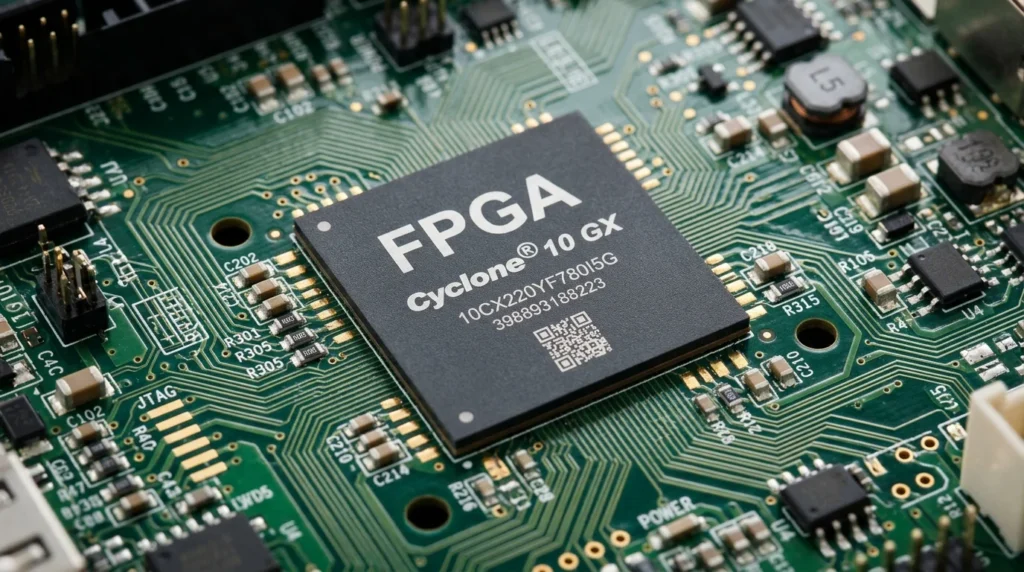
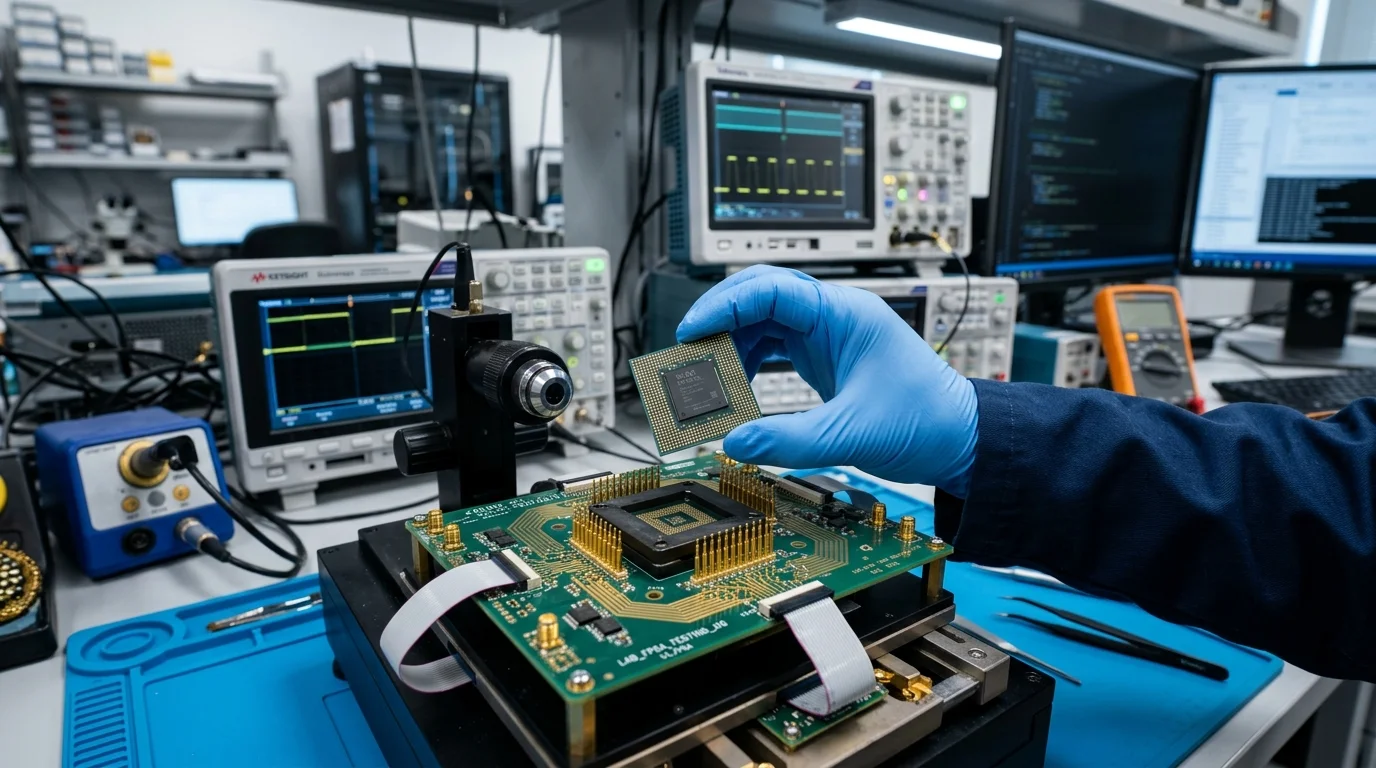
What Does “FPGA” Mean?
The most common FPGA meaning is:
Field-Programmable Gate Array
Let’s break down the FPGA meaning word by word:
Quick Definition
- Field = Programmed by the user after manufacturing
- Programmable = Can be configured and reconfigured
- Gate = Refers to logic gates used in digital circuits
- Array = A collection of programmable logic blocks
In simple terms, the FPGA meaning refers to a customizable computer chip that can be programmed to perform specific hardware functions.
What It Usually Means in Technology Discussions
When engineers discuss FPGA devices, they’re usually referring to chips that allow custom digital circuit creation without manufacturing a new chip from scratch.
Unlike a CPU that executes software instructions, an FPGA can be configured to become specialized hardware.
What Tone Does It Convey?
The FPGA meaning is generally technical and professional. It is commonly used in:
- Electronics engineering
- Computer architecture
- Embedded systems
- AI acceleration
- Telecommunications
- Hardware development
What Does FPGA Mean on Different Platforms?
Although the FPGA meaning remains consistent, the context can vary depending on where you see it.
Text Messages
FPGA is rarely used in casual texting. When it appears, it usually refers to technology or engineering discussions.
Professionals often mention FPGA skills, FPGA design experience, and FPGA development projects.
Technology communities frequently discuss FPGA programming, FPGA boards, and FPGA learning resources.
Discord
Engineering and gaming hardware servers may discuss FPGA hardware projects and retro gaming implementations.
YouTube
Many educational channels explain the FPGA meaning through tutorials and demonstrations.
Developer Forums
FPGA often appears in conversations about digital logic design, hardware acceleration, and embedded systems.
Job Listings
Employers frequently seek FPGA engineers for specialized hardware development roles.
Origin and History of FPGA
Understanding the FPGA meaning also requires understanding its history.
Early Development
The FPGA concept emerged during the 1980s when engineers wanted more flexible alternatives to fixed-function integrated circuits.
Commercial Introduction
The first commercially successful FPGA devices appeared in the mid-1980s. These devices allowed users to configure hardware functionality after manufacturing.
Industry Adoption
As technology advanced, FPGA devices became more powerful and found applications in:
- Networking equipment
- Defense systems
- Telecommunications
- Consumer electronics
- Data centers
Modern FPGA Technology
Today, FPGA technology supports:
- Artificial intelligence
- Machine learning acceleration
- 5G infrastructure
- Autonomous vehicles
- Cloud computing
The FPGA meaning has evolved from a niche engineering concept into a critical component of modern technology.
How FPGA Technology Actually Works
To fully understand the FPGA meaning, it’s important to know how these devices operate.
Programmable Logic Blocks
An FPGA contains thousands or even millions of programmable logic elements.
These blocks can be connected in different ways to create custom hardware circuits.
Interconnect Network
A routing system connects various logic blocks together.
This allows designers to create complex digital systems.
Input and Output Connections
FPGAs communicate with external devices through configurable input and output pins.
Reconfiguration
One of the most important aspects of the FPGA meaning is reprogrammability.
Users can:
- Modify designs
- Improve functionality
- Fix issues
- Add new features
Without replacing the hardware.
How People Actually Use FPGA
Most people encounter FPGA technology without realizing it.
Telecommunications
Many networking devices rely on FPGA hardware for signal processing.
Aerospace
Aircraft systems often use FPGA-based solutions because of their flexibility and reliability.
Automotive Industry
Modern vehicles increasingly incorporate FPGA technology.
Artificial Intelligence
AI applications use FPGA accelerators to improve performance.
Medical Equipment
Many diagnostic and imaging systems use FPGA technology.
Research and Education
Universities frequently use FPGA development boards to teach digital design.
Most engineers use FPGA devices when they need custom hardware performance without the expense of creating a custom chip.
Real Examples of FPGA in Action
Here are practical examples that help explain the FPGA meaning.
Example 1: Video Processing
System Designer:
“We need faster video processing.”
Engineer:
“Let’s implement it on an FPGA.”
Meaning: Custom hardware acceleration.
Why It Was Used: Better performance.
Example 2: AI Inference
Developer:
“Our AI model is running slowly.”
Engineer:
“An FPGA accelerator could help.”
Meaning: Hardware optimization.
Why It Was Used: Improved speed.
Example 3: Telecommunications
Manager:
“Can the network equipment be upgraded?”
Engineer:
“Yes, the FPGA can be reconfigured.”
Meaning: Flexible hardware updates.
Why It Was Used: Reduced hardware replacement costs.
Example 4: University Project
Student:
“What board should I use?”
Professor:
“Start with an FPGA development kit.”
Meaning: Educational hardware platform.
Why It Was Used: Learning digital design.
Example 5: Embedded Systems
Developer:
“We need real-time processing.”
Engineer:
“FPGA hardware can handle it.”
Meaning: High-performance computing.
Why It Was Used: Low latency.
Example 6: Data Centers
Administrator:
“Can we improve efficiency?”
Engineer:
“Deploy FPGA accelerators.”
Meaning: Hardware optimization.
Why It Was Used: Better performance per watt.
Example 7: Robotics
Designer:
“The robot needs faster control loops.”
Engineer:
“Use FPGA logic.”
Meaning: Real-time processing.
Why It Was Used: Precise control.
Example 8: Automotive Systems
Engineer:
“We need advanced sensor processing.”
Manager:
“Let’s evaluate FPGA solutions.”
Meaning: Flexible hardware design.
Why It Was Used: Rapid development.
Example 9: Security Systems
Developer:
“Can encryption run faster?”
Engineer:
“FPGA implementation can help.”
Meaning: Hardware acceleration.
Why It Was Used: Improved performance.
Example 10: Research Laboratory
Researcher:
“We need custom hardware.”
Engineer:
“An FPGA is ideal.”
Meaning: Customizable computing platform.
Why It Was Used: Flexibility.
Common Mistakes and Misunderstandings
Many beginners misunderstand the FPGA meaning.
Mistake 1: FPGA Is a CPU
An FPGA is not a traditional processor.
Mistake 2: FPGA Is Software
An FPGA implements hardware logic rather than simply running software.
Mistake 3: FPGA Is Obsolete
Modern FPGA devices remain widely used.
Mistake 4: FPGA Is Only for Experts
While advanced designs can be complex, beginners can learn FPGA development through educational boards.
Mistake 5: FPGA and ASIC Are the Same
ASICs are fixed-function chips, while FPGA devices are programmable.
Similar Technology Terms and Related Abbreviations
| Term | Meaning | Difference |
|---|---|---|
| FPGA | Field-Programmable Gate Array | Reprogrammable hardware |
| ASIC | Application-Specific Integrated Circuit | Fixed hardware |
| CPU | Central Processing Unit | General-purpose processing |
| GPU | Graphics Processing Unit | Parallel processing |
| MCU | Microcontroller Unit | Embedded control |
| DSP | Digital Signal Processor | Signal processing focus |
| SoC | System on Chip | Multiple functions integrated |
| HDL | Hardware Description Language | Used to design FPGA logic |
| VHDL | VHSIC Hardware Description Language | FPGA design language |
| Verilog | Hardware design language | FPGA programming language |
These terms are often discussed alongside the FPGA meaning in engineering and computer science.
Is FPGA Positive, Negative, or Neutral?
The FPGA meaning is generally neutral.
However, in engineering discussions, FPGA often carries positive associations because it offers:
- Flexibility
- Reusability
- Performance
- Rapid prototyping
Some developers may view FPGA development as challenging because it requires hardware design knowledge.
Overall, the FPGA meaning is usually associated with advanced and powerful technology solutions.
Should You Learn About FPGA?
Use FPGA If:
- You are interested in digital electronics.
- You want to learn hardware design.
- You work with embedded systems.
- You develop high-performance applications.
Avoid FPGA If:
- Your project only needs simple software solutions.
- You have no need for custom hardware acceleration.
For many engineering careers, understanding the FPGA meaning can be highly valuable.