
What Does “Plasma” Mean?
Quick Definition
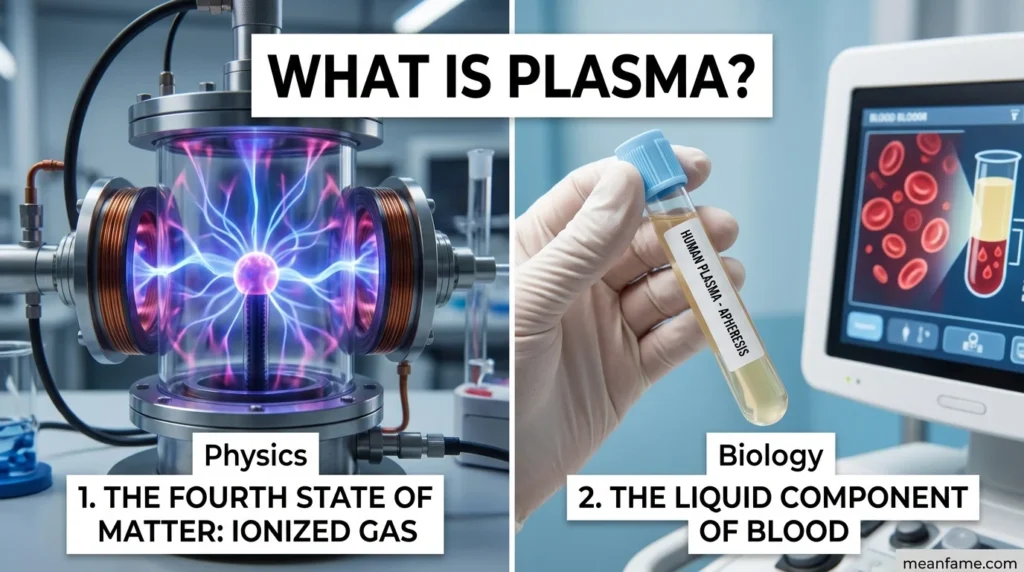
Plasma can mean:
- The fourth state of matter, consisting of ionized gas.
- The liquid component of blood that carries blood cells and other substances.
- A substance used in scientific and medical contexts.
What It Usually Means
The word commonly refers to:
- Blood plasma
- Plasma donations
- Plasma TVs (older technology)
- Space plasma
- Lightning
- The Sun and stars
Most Common Interpretation
The meaning depends on the topic:
- In healthcare, plasma usually means the liquid part of blood.
- In physics, plasma refers to ionized gas with freely moving charged particles.
What Tone Does It Convey?
Depending on the context, plasma may convey:
- Science
- Medicine
- Technology
- Healthcare
- Space
Plasma Meaning in Different Contexts
Medicine
In medicine, blood plasma is the straw-colored liquid that makes up about 55% of your blood. It transports:
- Red blood cells
- White blood cells
- Platelets
- Nutrients
- Hormones
- Antibodies
- Waste products
Example:
“She donated plasma to help patients in need.”
Physics
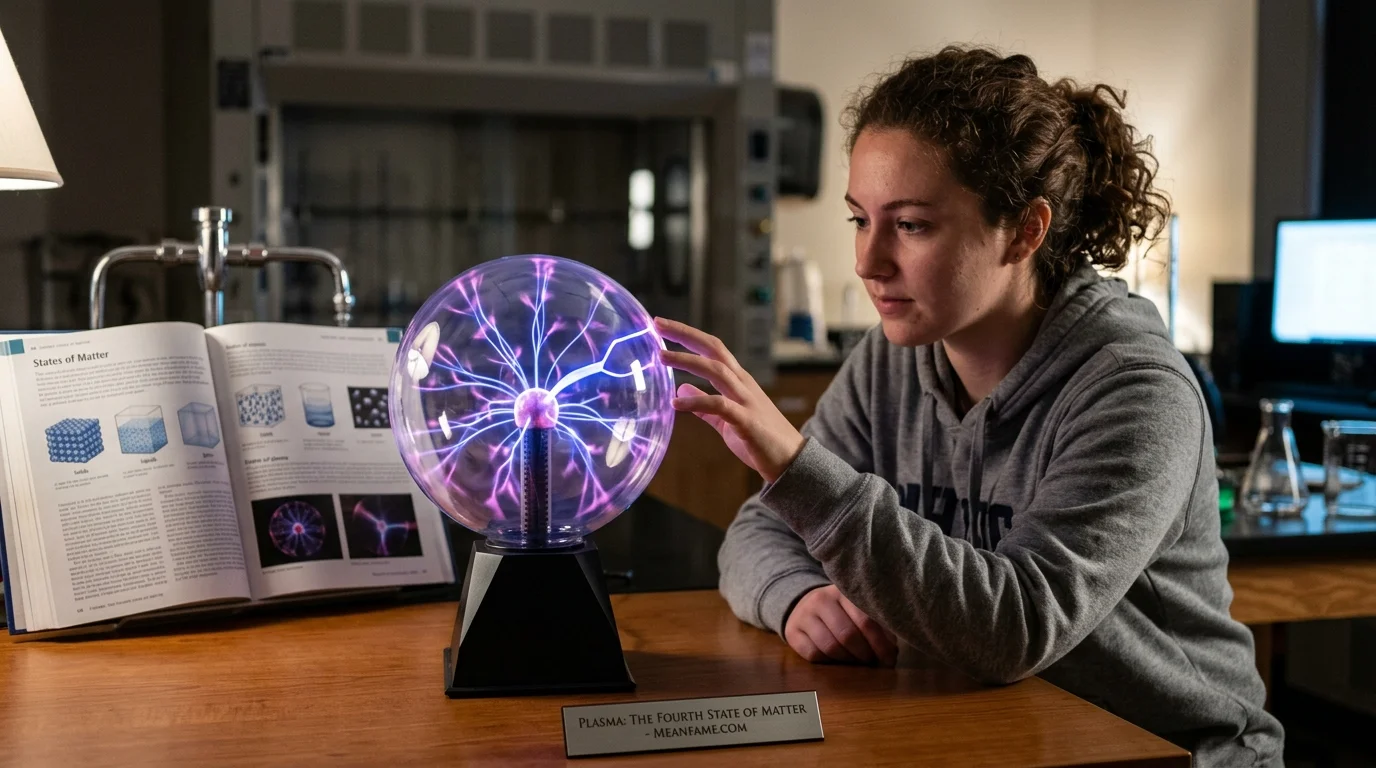
In physics, plasma is the fourth state of matter, alongside solids, liquids, and gases. It forms when a gas is heated or energized so much that electrons separate from atoms.
Examples include:
- The Sun
- Stars
- Lightning
- Neon signs
- Aurora borealis
Biology
Biologists use plasma in terms such as:
- Cell plasma (cytoplasm in older usage)
- Blood plasma
Technology
The word also appears in plasma cutting, plasma displays, and industrial manufacturing.
Origin and History of Plasma
The word plasma comes from the Greek word plasma, meaning “something molded or formed.” It entered scientific vocabulary in the 19th century.
The term blood plasma became widely used in medicine in the early 20th century, while physicists later adopted plasma to describe ionized gases because they behave like a fluid carrying charged particles.
How People Actually Use Plasma
Meaning 1: Blood Plasma
Example:
“The hospital needs more plasma donations.”
Meaning:
The liquid part of donated blood.
Meaning 2: State of Matter
Example:
“The Sun is mostly plasma.”
Meaning:
Hot ionized gas.
Meaning 3: Plasma TV
Example:
“They replaced their old plasma TV.”
Meaning:
A television that uses plasma display technology.
Meaning 4: Industrial Plasma
Example:
“The factory uses plasma cutters.”
Meaning:
Machines that cut metal using high-temperature plasma.
Real Examples of Plasma in Conversations
Example 1
Student: What does plasma mean?
Teacher: It can refer to the liquid part of blood or the fourth state of matter, depending on the context.
Example 2
Doctor: Your plasma donation could save lives.
Meaning: Donating the liquid portion of blood.
Example 3
Science Teacher: Lightning is an example of plasma.
Meaning: Ionized gas.
Example 4
Friend: I donated plasma today.
Meaning: Blood plasma.
Example 5
Astronomer: Most of the visible universe is made of plasma.
Meaning: Ionized matter.
Example 6
Technician: The plasma cutter slices through steel easily.
Meaning: Industrial cutting tool.
Example 7
Patient: My plasma proteins are normal.
Meaning: Proteins found in blood plasma.
Example 8
Electrician: Neon signs contain plasma.
Meaning: Electrically energized gas.
Example 9
Family Member: We finally replaced our plasma TV.
Meaning: Television using plasma display technology.
Example 10
Researcher: Plasma behaves differently from ordinary gases.
Meaning: The fourth state of matter.
Common Mistakes and Misunderstandings
Mistake 1: Thinking Plasma Only Means Blood
Plasma also refers to the fourth state of matter in physics.
Mistake 2: Confusing Plasma with Serum
- Plasma contains clotting proteins.
- Serum is plasma after the clotting proteins have been removed.
Mistake 3: Believing Plasma Is Rare
Plasma is actually the most common state of ordinary matter in the visible universe, since stars are primarily made of plasma.
Mistake 4: Assuming Plasma TVs Use Blood Plasma
Plasma televisions use tiny cells filled with ionized gases—not blood.
Similar Words and Related Terms
| Word | Meaning | Difference |
|---|---|---|
| Plasma | Ionized gas or blood’s liquid component | Main term |
| Blood | Fluid circulating through the body | Includes plasma and blood cells |
| Serum | Liquid remaining after blood clots | Lacks clotting proteins |
| Cytoplasm | Material inside a cell | Different biological term |
| Gas | One state of matter | Plasma is ionized gas |
| Ion | Electrically charged atom or molecule | Building block of plasma |
| Electrolyte | Mineral carrying electric charge | Found in blood plasma |
| Platelet | Blood cell fragment | Suspended in plasma |
| Red Blood Cell | Oxygen-carrying blood cell | Travels through plasma |
| White Blood Cell | Immune system cell | Also carried by plasma |
Is Plasma Positive, Negative, or Neutral?
The plasma meaning is neutral.
Positive Uses
- Plasma donations save lives.
- Plasma research advances science.
- Plasma cutting improves manufacturing.
Neutral Uses
- Describing stars.
- Explaining blood composition.
- Discussing technology.
The word itself carries no positive or negative emotion.
Should You Use the Word Plasma?
Use It If
- You’re discussing medicine, healthcare, science, or physics.
- You need the correct scientific or medical term.
- Precision is important.
Avoid It If
- Your audience may confuse blood plasma with the physics meaning—provide context if necessary.