
What Does “SAI” Mean in FAFSA?
Quick Definition
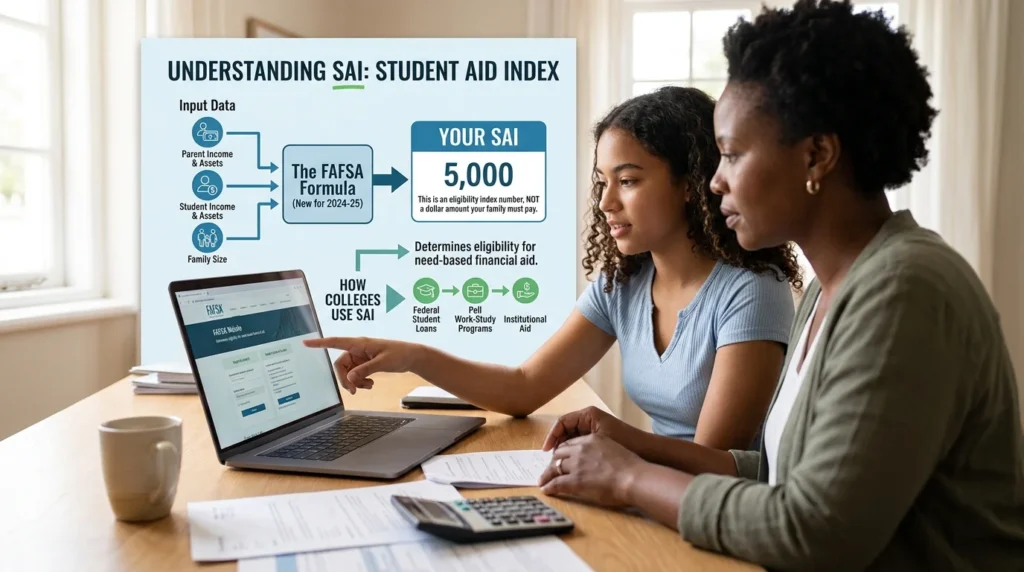
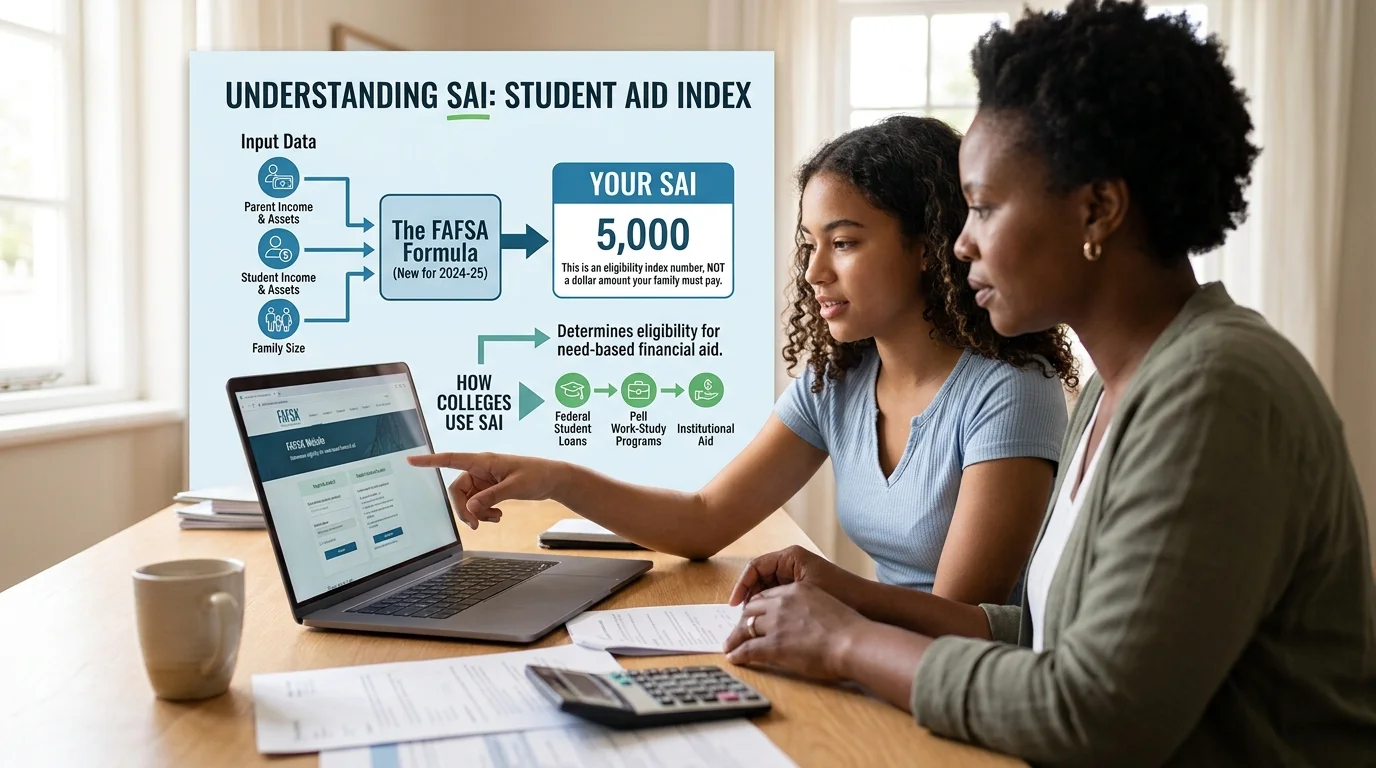
SAI stands for Student Aid Index.
It is a number used to:
- Determine eligibility for federal student aid.
- Help colleges calculate financial aid awards.
- Estimate a student’s financial need.
What It Usually Means
When someone asks about SAI meaning FAFSA, they’re usually referring to:
- Financial aid eligibility.
- Federal grants.
- Student loans.
- Work-study programs.
- College affordability.
Most Common Interpretation
Your SAI represents a measure used by financial aid administrators to assess how much financial assistance you may qualify for. A lower SAI generally indicates greater financial need.
What Does SAI Mean for Financial Aid?
Federal Pell Grants
Students with lower SAIs are generally more likely to qualify for larger Pell Grant awards, if they meet other eligibility requirements.
Federal Student Loans
Your FAFSA information helps determine eligibility for federal student loans, though loan eligibility is not based solely on your SAI.
Work-Study
Many colleges consider SAI when awarding Federal Work-Study opportunities.
Institutional Aid
Colleges often use the SAI, along with their own policies, to distribute scholarships and institutional grants.
How Is the Student Aid Index Calculated?
The U.S. Department of Education calculates your SAI using information reported on your FAFSA, including factors such as:
- Income
- Assets (when applicable)
- Family size
- Tax information
- Marital status (if applicable)
- Other FAFSA data required by federal law
The exact formula is established by federal regulations and may change over time.
What Do Different SAI Numbers Mean?
Here’s a general guide:
| Student Aid Index (SAI) | What It May Indicate |
|---|---|
| Negative SAI | Very high financial need |
| 0 | Significant financial need |
| Low positive SAI | Moderate financial need |
| Higher positive SAI | Lower demonstrated financial need |
Remember, SAI is only one factor used in determining financial aid.
Common Misunderstandings About SAI
Mistake 1: SAI Is Your College Bill
False.
Your SAI is not the amount you must pay for college.
Mistake 2: A High SAI Means No Aid
Not necessarily.
Many colleges offer scholarships, merit aid, institutional grants, and other assistance regardless of SAI.
Mistake 3: SAI Is the Same as EFC
Not exactly.
The Student Aid Index replaced the Expected Family Contribution, but the calculation and terminology have changed.
Mistake 4: Only Income Matters
Income is important, but other FAFSA information may also affect your SAI.
Real Examples
Example 1
Student: My FAFSA shows an SAI of 500.
Meaning: The financial aid office will use this number to help determine aid eligibility.
Example 2
Parent: Does my SAI tell me exactly what I’ll pay?
Counselor: No. It’s only one factor used to calculate your financial aid package.
Example 3
Student: My SAI is negative.
Advisor: That generally indicates very high financial need under the FAFSA formula.
Example 4
Friend: I thought SAI replaced EFC.
Friend 2: That’s correct. The Student Aid Index is the newer system.
Example 5
College Representative: Your financial aid offer considers your SAI along with our institutional policies.
Similar Financial Aid Terms
| Term | Meaning | Difference |
| SAI | Student Aid Index | Main FAFSA financial need measure |
| FAFSA | Free Application for Federal Student Aid | Application used to determine aid |
| EFC | Expected Family Contribution | Previous system replaced by SAI |
| Pell Grant | Federal grant for eligible students | Does not require repayment |
| Work-Study | Federal student employment program | Helps students earn money while studying |
| Cost of Attendance (COA) | Estimated annual college expenses | Includes tuition, housing, books, and more |
| Federal Student Loan | Government-backed education loan | Usually must be repaid |
| Scholarship | Financial award | Often based on merit or other criteria |
| Grant | Financial aid that usually doesn’t require repayment | Often based on financial need |
| Financial Aid Package | Combined aid offered by a college | May include grants, loans, scholarships, and work-study |
Is SAI Good or Bad?
The SAI meaning FAFSA is neutral.
Lower SAI
Generally indicates greater financial need and may increase eligibility for need-based aid.
Higher SAI
Generally indicates lower demonstrated financial need, but students may still qualify for scholarships, loans, merit aid, or institutional assistance.
Should You Pay Attention to Your SAI?
Yes.
Your Student Aid Index can help you:
- Understand your financial aid eligibility.
- Compare college aid offers.
- Prepare for college costs.
- Plan your education budget.
However, remember that your SAI alone does not determine your total financial aid award.