
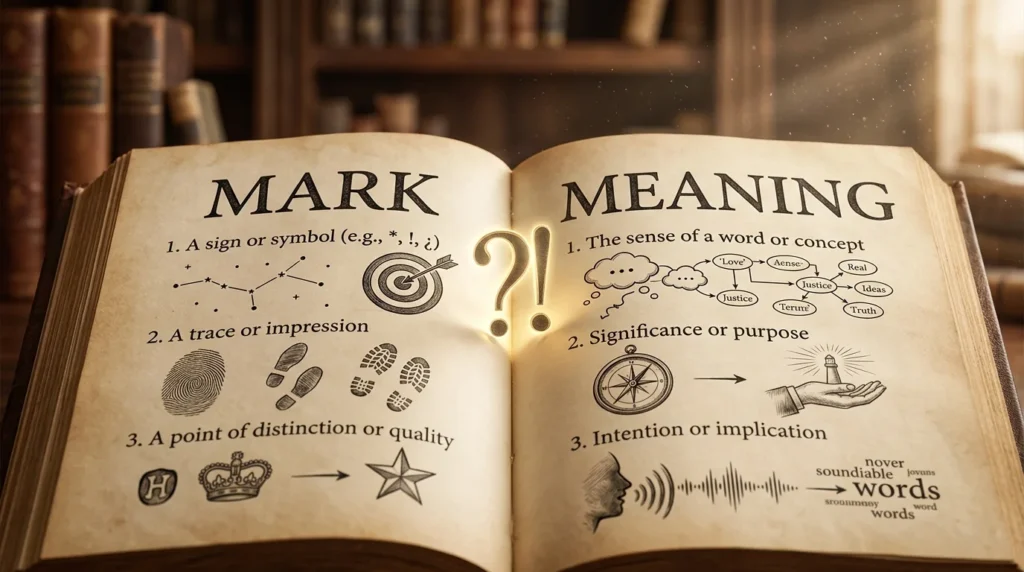

What Does “Mark” Mean?
Quick Definition
Mark can mean:
- A visible sign, spot, or stain.
- A score or grade.
- A symbol, label, or indication.
- A target or intended victim.
- To identify, label, or notice something.
What It Usually Means
The word commonly refers to:
- Exam grades
- Spots or scratches
- Written symbols
- Targets
- Measurements
- Identifying information
Literal Meaning
A mark is a visible sign left on a surface or an indication showing location or identity.
Slang Meaning
In slang, mark often means a person chosen as the target of a scam, trick, or fraud. In professional wrestling, a mark traditionally refers to someone who believes the scripted storylines are real or is deeply invested as a fan.
Most Common Interpretation
Most people use mark to describe a visible sign or an exam score.
What Tone Does It Convey?
Depending on the context, mark can convey:
- Identification
- Achievement
- Damage
- Recognition
- Targeting
What Does Mark Mean in Different Contexts?
Education
In British English and many Commonwealth countries, mark means a student’s score on a test or assignment.
Example:
“She received full marks on the exam.”
Everyday Conversation
A mark can be a stain, scratch, or spot.
Example:
“There’s a mark on your shirt.”
Business
People mark documents to indicate corrections or important information.
Sports
In sports like soccer, basketball, and football, to mark means to closely guard an opponent.
Slang
In criminal slang, a mark is the intended victim of a scam or con.
Origin and History of Mark
The word mark comes from the Old English mearc, meaning boundary, sign, or indication. Over centuries, its meaning expanded to include grades, symbols, targets, and physical signs.
Because of its long history, mark has become one of the most versatile words in the English language.
How People Actually Use Mark
Meaning 1: Visible Sign
Example:
“The table has a burn mark.”
Meaning:
A visible spot caused by heat.
Meaning 2: Grade
Example:
“He earned the highest mark in mathematics.”
Meaning:
The best exam score.
Meaning 3: Label or Symbol
Example:
“Mark the correct answer.”
Meaning:
Indicate the right choice.
Meaning 4: Target
Example:
“The scammer picked an easy mark.”
Meaning:
A victim chosen for deception.
Meaning 5: Observe or Celebrate
Example:
“The city marked its 100th anniversary.”
Meaning:
Officially recognized or celebrated an event.
When People Use It
You’ll often hear mark in:
- Schools
- Offices
- Sports
- Retail
- Law enforcement
- Everyday conversations
Real Examples of Mark in Conversations
Example 1
Teacher: You got a perfect mark.
Meaning: Excellent exam score.
Why it was used: Education.
Example 2
Friend: There’s a coffee mark on your notebook.
Meaning: A visible stain.
Why it was used: Casual conversation.
Example 3
Coach: Mark your opponent closely.
Meaning: Guard them during the game.
Why it was used: Sports.
Example 4
Student: What does mark mean?
Teacher: It can mean a sign, score, target, or symbol depending on the context.
Meaning: Vocabulary lesson.
Why it was used: Education.
Example 5
Editor: Please mark the mistakes in red.
Meaning: Identify or highlight errors.
Why it was used: Workplace discussion.
Example 6
Reporter: The country marked Independence Day with celebrations.
Meaning: Celebrated an event.
Why it was used: News reporting.
Example 7
Detective: The con artist searched for an easy mark.
Meaning: A scam victim.
Why it was used: Crime discussion.
Example 8
Friend: I left a bookmark to mark my place.
Meaning: Indicate a location.
Why it was used: Reading.
Example 9
Customer: The furniture has a scratch mark.
Meaning: Visible damage.
Why it was used: Shopping.
Example 10
Athlete: I stayed close to mark the striker.
Meaning: Defend against an opponent.
Why it was used: Soccer.
Common Mistakes and Misunderstandings
Mistake 1: Thinking Mark Only Means a Grade
The word has many meanings beyond school scores.
Mistake 2: Confusing Mark with Marker
A mark is a sign or indication, while a marker is often a pen or an object used to create a mark.
Mistake 3: Assuming Slang Meaning Is Always Intended
When someone says “good mark,” they usually mean a score—not a scam target.
Mistake 4: Ignoring Context
The meaning changes depending on whether you’re talking about education, sports, business, crime, or everyday life.
Similar Words and Related Terms
| Word | Meaning | Difference |
|---|---|---|
| Mark | Sign, score, target, or symbol | Main concept |
| Sign | Visible indication | Broader term |
| Spot | Small visible area | Physical only |
| Grade | Academic score | Education-specific |
| Score | Number of points | Broader than grades |
| Label | Written identification | Information-focused |
| Symbol | Graphic representation | Abstract meaning |
| Stain | Permanent discoloration | Physical mark |
| Scratch | Surface damage | Type of mark |
| Target | Intended object or person | Similar slang meaning |
Is Mark Positive, Negative, or Neutral?
The mark meaning is generally neutral.
Positive Uses
- High exam marks.
- Marking achievements.
- Positive recognition.
Neutral Uses
- A mark on paper.
- Marking a location.
- Measuring progress.
Negative Uses
- A stain or scratch.
- A target for fraud.
- A criminal “mark.”
Should You Use the Word Mark?
Use It If
- You’re referring to a sign, score, label, or indication.
- You’re discussing education, sports, or business.
- The context clearly identifies which meaning you intend.
Avoid It If
- A more specific word like grade, scratch, label, or target would make your meaning clearer.