
What Does “PWM” Mean?
Quick Definition
PWM stands for Pulse Width Modulation, a method of controlling electrical power by varying the width of pulses in a repeating signal.
What It Usually Means
In electronics, PWM is used to regulate:
- Motor speed
- LED brightness
- Fan speed
- Heating elements
- Power supplies
Literal Meaning
The abbreviation breaks down as follows:
- Pulse = A brief electrical signal.
- Width = How long the signal stays on.
- Modulation = Adjusting or controlling a signal.
Most Common Interpretation
Most people encounter PWM when controlling brightness, speed, or power in electronic devices.
What Tone Does It Convey?
PWM is a technical and neutral engineering term.
What Does PWM Mean in Different Contexts?
Electronics
PWM is widely used to control electrical power efficiently.
Microcontrollers
Devices such as Arduino boards frequently use PWM outputs to control LEDs and motors.
Computer Hardware
PWM is commonly used to regulate cooling fan speeds.
Automotive Systems
Electric vehicles and modern cars rely on PWM for motor control and electronic systems.
Industrial Equipment
Factories use PWM in robotics, automation, and machinery control.
Renewable Energy
Solar power systems often use PWM charge controllers to regulate battery charging.
How Does PWM Work?
Basic Principle
PWM rapidly switches power:
- ON
- OFF
- ON
- OFF
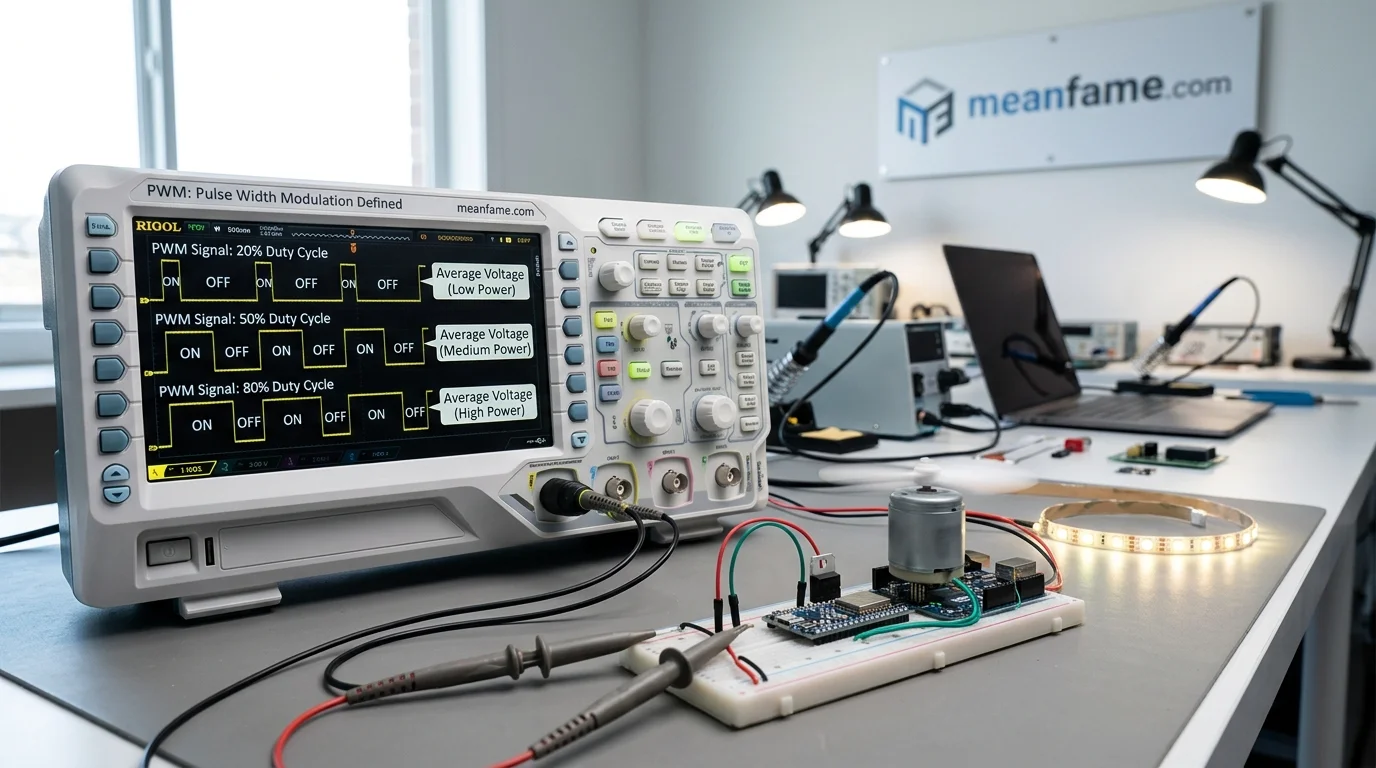
This switching occurs so quickly that the connected device responds as though it is receiving a continuous average power level.
Duty Cycle
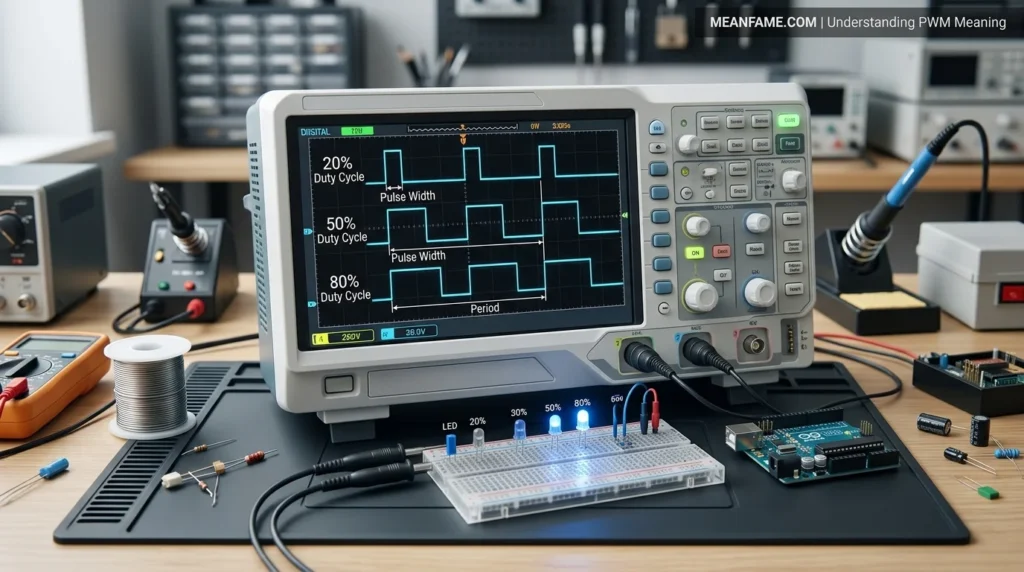
The most important PWM concept is the duty cycle.
The duty cycle represents the percentage of time the signal stays ON during one cycle.
Examples:
- 25% duty cycle = Low power
- 50% duty cycle = Medium power
- 75% duty cycle = High power
- 100% duty cycle = Full power
Visual Example
This illustrates a repeating on/off waveform similar to how PWM signals operate.
Origin and History of PWM
Pulse Width Modulation developed alongside advances in electronics and power control systems.
As engineers sought more efficient methods of controlling electrical devices, PWM became a preferred solution because it reduces wasted energy compared to traditional resistive control methods.
Over time, PWM became essential in:
- Consumer electronics
- Industrial automation
- Telecommunications
- Automotive engineering
- Renewable energy systems
Today, PWM is a standard technology used worldwide.
How People Actually Use PWM
Most people use PWM without realizing it.
Common examples include:
- Dimming LED lights
- Controlling ceiling fans
- Adjusting computer fan speed
- Operating drones
- Driving electric motors
- Managing battery chargers
When PWM Is Used
PWM is ideal when:
- Efficient power control is needed.
- Variable output is required.
- Energy savings are important.
Why Engineers Prefer PWM
Benefits include:
- High efficiency
- Reduced heat generation
- Precise control
- Lower energy waste
Real Examples of PWM in Everyday Life
Example 1
User: Why does my LED light dim?
Technician: It uses PWM control.
Meaning: Brightness is adjusted through pulse modulation.
Why it was used: Efficient lighting control.
Example 2
Computer Owner: My fan speed keeps changing.
Technician: PWM controls the fan automatically.
Meaning: Speed regulation.
Why it was used: Temperature management.
Example 3
Student: How does an Arduino fade an LED?
Teacher: Using PWM signals.
Meaning: Brightness control.
Why it was used: Educational example.
Example 4
Engineer: We need motor speed control.
Technician: PWM is the best solution.
Meaning: Power regulation.
Why it was used: Efficiency.
Example 5
Electric Vehicle Owner: How are motors controlled?
Engineer: PWM manages power delivery.
Meaning: Motor operation.
Why it was used: Performance control.
Example 6
DIY Hobbyist: My robot moves too fast.
Friend: Reduce the PWM duty cycle.
Meaning: Lower average power.
Why it was used: Speed adjustment.
Example 7
Solar Installer: This uses a PWM charge controller.
Meaning: Battery charging regulation.
Why it was used: Energy management.
Example 8
Factory Operator: The machine speed changed smoothly.
Engineer: PWM made that possible.
Meaning: Variable control.
Why it was used: Automation.
Example 9
Electronics Student: Is PWM efficient?
Professor: Extremely efficient for power control.
Meaning: Minimal energy waste.
Why it was used: Learning.
Example 10
Technician: Set PWM to 80%.
Meaning: Increase output power.
Why it was used: System tuning.
Common Mistakes and Misunderstandings
Mistake 1: Thinking PWM Changes Voltage Directly
PWM changes the average power delivered, not necessarily the supply voltage itself.
Mistake 2: Assuming PWM Is Only for Motors
PWM is used in many systems, including lighting, charging, and communication.
Mistake 3: Believing PWM Wastes Energy
PWM is generally more efficient than many traditional control methods.
Mistake 4: Confusing Duty Cycle With Frequency
Duty cycle and frequency are separate characteristics of a PWM signal.
How to Avoid Confusion
Remember:
- PWM = Pulse Width Modulation.
- It controls power using on/off pulses.
- Duty cycle determines average output.
- Higher duty cycle means more power.
Similar Terms and Related Concepts
| Term | Meaning | Difference |
|---|---|---|
| PWM | Pulse Width Modulation | Main concept |
| Duty Cycle | Percentage of ON time | PWM characteristic |
| Frequency | Number of cycles per second | Signal timing |
| Voltage | Electrical potential | Not the same as PWM |
| Current | Flow of electricity | Different measurement |
| DC Motor | Direct-current motor | Often controlled by PWM |
| AC Motor | Alternating-current motor | Different control methods |
| Microcontroller | Programmable control chip | Often generates PWM |
| Inverter | Converts electrical power | May use PWM internally |
| Power Supply | Provides electrical energy | Can utilize PWM regulation |
Is PWM Positive, Negative, or Neutral?
PWM is a neutral technical term.
Positive Associations
- Energy efficiency
- Precise control
- Modern electronics
- Reduced heat generation
Neutral Associations
- Engineering
- Circuit design
- Automation
Negative Associations
PWM itself is not negative, though poorly implemented PWM can sometimes cause noise or flickering.
Should You Learn About PWM?
Yes If
- You’re interested in electronics.
- You work with Arduino or microcontrollers.
- You study engineering.
- You build robots or DIY projects.
Less Important If
- You rarely interact with electronics concepts.
Even so, understanding PWM helps explain how many modern devices function.