

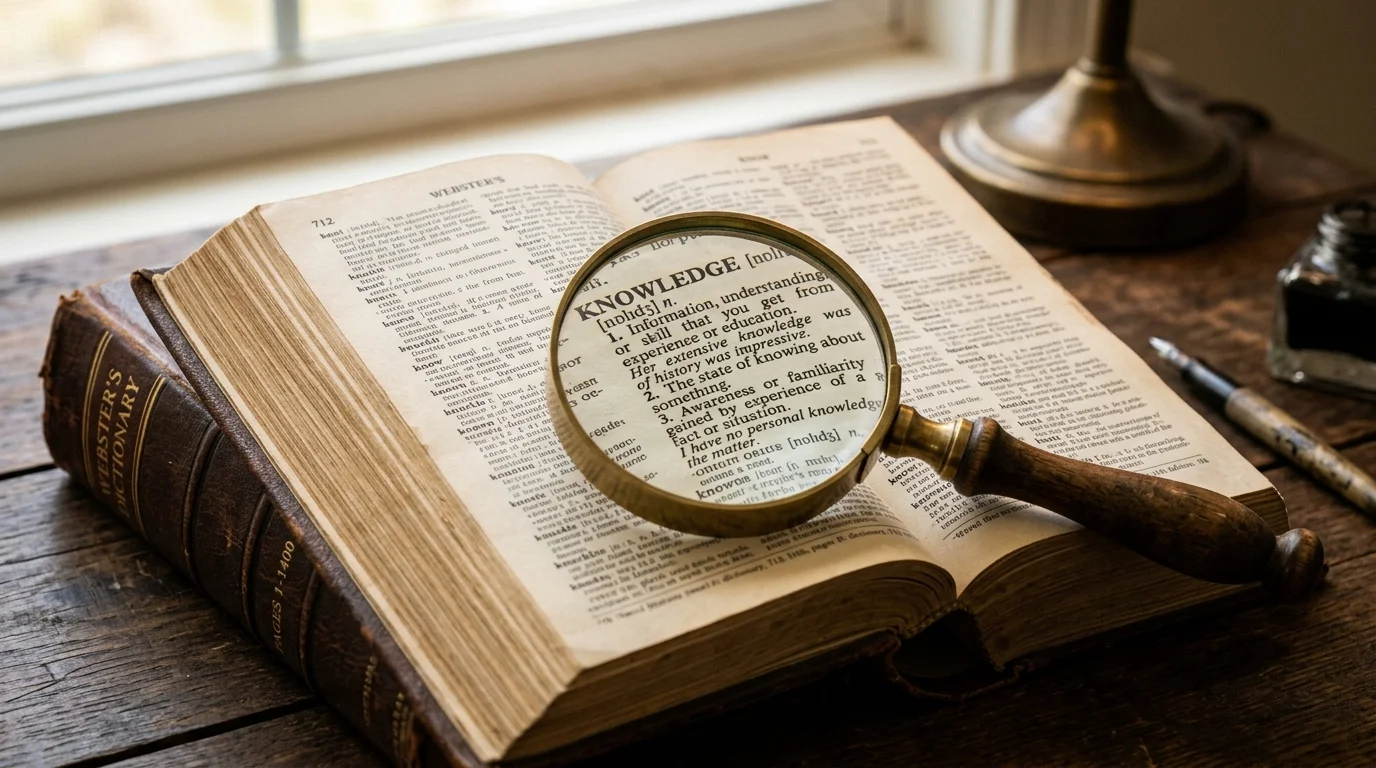
What Does “Definition Meaning” Mean?
Quick Definition
A definition is a statement that explains the meaning of a word, term, or concept. The definition meaning is the sense or significance that a definition conveys—it’s what the word stands for and how it’s understood.
What It Usually Means In Conversations
When people talk about the definition meaning in everyday conversation, they’re usually referring to one of these things:
The dictionary sense: The most common definition meaning is the explanation found in a dictionary. For example, “What’s the definition of ‘taciturn’?” means “What does ‘taciturn’ mean?”
The concept itself: The definition meaning can also refer to the broader idea of what it means to define something—the process of setting boundaries for a word’s meaning.
The significance: Sometimes “definition meaning” refers to the importance or significance of a concept, as in “What’s the definition of success?” meaning “What does success really mean?”
What Tone Does It Convey?
| Context | Tone | Example |
|---|---|---|
| Dictionary/Learning | Neutral, factual | “Look up the definition in the dictionary” |
| Philosophical | Deep, reflective | “What is the definition of truth?” |
| Legal | Precise, binding | “The legal definition of the term” |
| Everyday | Practical, helpful | “I need a clear definition of this concept” |
The History of the Word “Definition”
The definition meaning has a long and rich history.
Latin Roots
The word “definition” comes from the Latin “definire,” meaning “to set bounds to” or “to limit” . This is composed of:
de- (down, away)
finire (to bound, limit, set a boundary)
finis (boundary, limit)
The definition meaning is literally about setting boundaries—establishing the limits of what a word signifies.
The Concept Through History
Aristotle: The Greek philosopher was one of the first to develop a systematic theory of definition. He believed that definitions should capture the essence of a thing—what makes it what it is.
Medieval Philosophy: Philosophers debated whether definitions could capture the true essence of things or just our understanding of them.
Modern Era: Today, the definition meaning is understood in more practical terms—definitions are tools for communication and understanding, not metaphysical truths.
Types of Definitions
The definition meaning can take many forms. Here are the most common types:
1. Formal Definitions
A formal definition follows a specific structure: the term being defined is placed in a class and then distinguished from other members of that class.
Structure: [Term] is a [class] that [distinguishing features].
Example: “A triangle is a polygon that has three sides and three angles.”
2. Extension Definitions
An extension definition lists examples of what the term refers to. Instead of describing the concept abstractly, it shows you what it includes.
Example: “Fruit includes apples, oranges, bananas, and strawberries.”
3. Ostensive Definitions
An ostensive definition points to examples of the term. It’s the most direct way to define something—showing it rather than describing it.
Example: Pointing to a dog and saying, “That is a dog.”
4. Operational Definitions
An operational definition specifies how to measure or identify something in practical terms.
Example: “Intelligence is defined by IQ score.”
5. Persuasive Definitions
A persuasive definition tries to change how you think about a concept by defining it in a particular way.
Example: “Democracy is tyranny of the majority.”
6. Enumerative Definitions
An enumerative definition lists all the things that belong to a category.
Example: “The United States is Alabama, Alaska, Arizona…” (listing all 50 states).
Why Definitions Matter
The definition meaning is more than just an academic exercise. Definitions matter for many reasons:
For Clear Communication
Without clear definitions, communication breaks down. If you and I have different definitions of “freedom” or “success,” we might think we’re agreeing when we’re actually talking about different things.
For Learning
Defining terms is essential for learning. Understanding the definition meaning of new words is the first step to understanding new concepts.
For Law and Politics
Legal definitions are crucial. The exact definition meaning of terms like “murder,” “negligence,” or “freedom of speech” can determine the outcome of court cases.
For Science
Scientific progress depends on precise definitions. If researchers don’t define their terms consistently, their findings may be meaningless or impossible to reproduce.
For Critical Thinking
Understanding the definition meaning of key terms is essential for critical thinking. When you evaluate an argument, you need to know exactly what the terms mean.
Real Examples of Definitions in Conversations
Example 1: Looking Up a Word
Person A: “What’s the definition of ‘taciturn’?”
Person B: “It means habitually quiet or reserved.”
Meaning: Seeking the definition meaning of a word.
Why it was used: To understand a new word.
Example 2: Clarifying a Concept
Person A: “What do you mean by ‘success’?”
Person B: “My definition is achieving your goals while maintaining integrity.”
Meaning: Providing a personal definition meaning.
Why it was used: To clarify a personal value.
Example 3: Legal Context
Person A: “What is the legal definition of ‘self-defense’?”
Person B: “It’s the use of reasonable force to protect yourself from harm.”
Meaning: Seeking the precise definition meaning in law.
Why it was used: To understand a legal concept.
Example 4: Philosophical Discussion
Person A: “What’s the definition of truth?”
Person B: “That’s a complex question. Philosophers have debated it for centuries.”
Meaning: Exploring the deeper definition meaning.
Why it was used: To engage in philosophical inquiry.
Example 5: Teaching
Person A: “How do you teach new vocabulary?”
Person B: “I start by giving a clear definition, then I show examples.”
Meaning: Using the definition meaning in education.
Why it was used: To describe a teaching method.
Common Mistakes and Misunderstandings
Confusing Definition with Meaning
Myth: “Definition” and “meaning” are the same thing.
Reality: A definition is the statement that explains a word’s meaning. The meaning is the sense or significance itself.
Assuming Definitions Are Fixed
Myth: Definitions are permanent and unchanging.
Reality: Definitions change over time as language evolves. The definition meaning of a word can shift across decades or centuries.
Believing Definitions Capture the Full Essence
Myth: A definition captures everything important about a concept.
Reality: Definitions are approximations. They simplify complex concepts for practical communication.
Thinking All Definitions Are Objective
Myth: Definitions are purely objective and value-free.
Reality: Definitions often reflect cultural biases and power structures. Who gets to define a term can be a political question.
Similar Terms and Related Words
| Term | Meaning | Connection to Definition |
|---|---|---|
| Meaning | The sense or significance of a word | The thing a definition explains |
| Explanation | A statement that makes something understandable | Similar to definition but broader |
| Interpretation | An understanding of meaning | Can overlap with definition |
| Clarification | Making something easier to understand | A synonym for explaining or defining |
Is “Definition” Positive, Negative, or Neutral?
The definition meaning is neutral. It’s a tool for communication and understanding.
Neutral aspects:
Definitions can be used for good or ill
They can clarify or obscure
They can be accurate or misleading
Positive aspects:
Enable clear communication
Essential for learning
Foundation of shared understanding
Negative aspects:
Can be used to manipulate
Can be overly rigid
Can exclude alternative viewpoints
Should You Use “Definition”?
You might use it when:
Looking up a word
Clarifying a concept
Teaching or learning
Discussing language
You should avoid it if:
You want to avoid sounding academic
The context is too casual