What Does “Vale” Mean?
The word vale has two primary meanings depending on the context.
Quick Definition
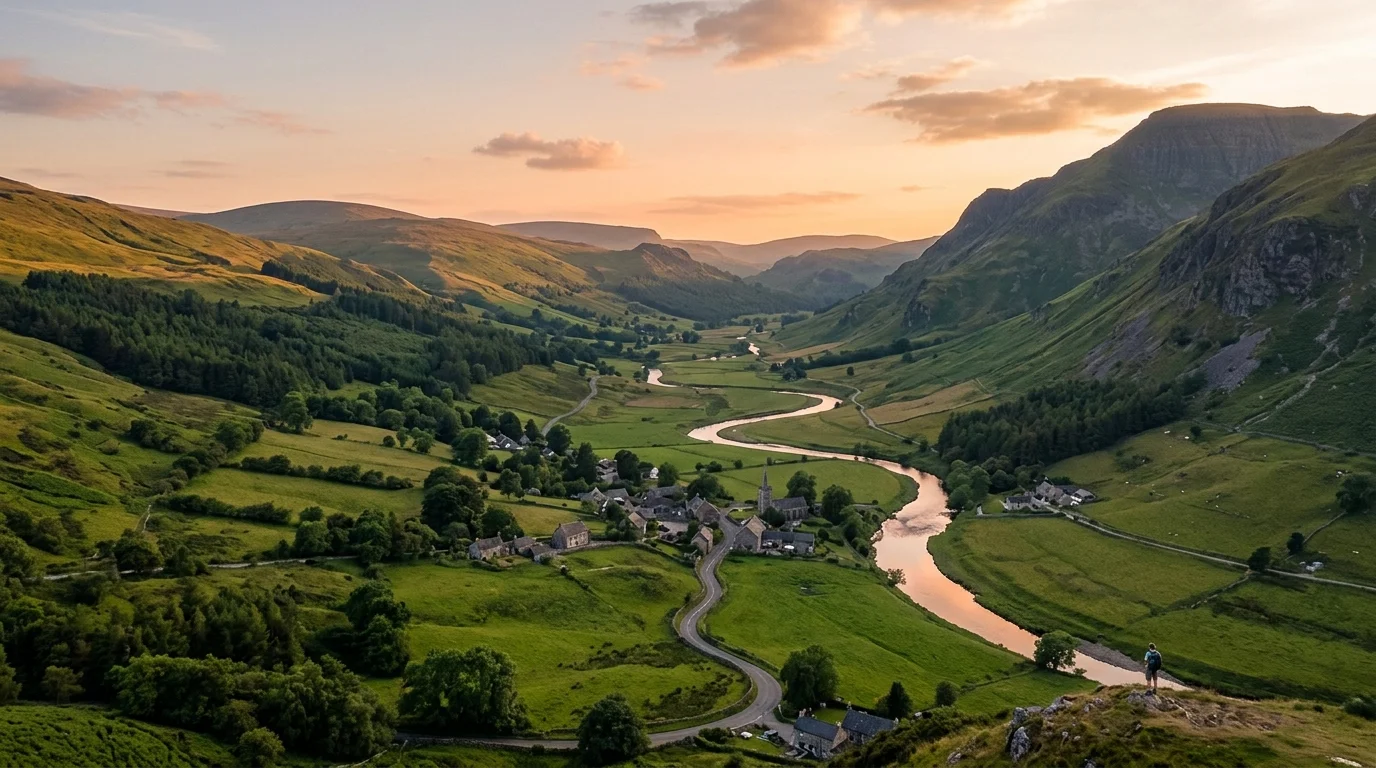
Vale (noun): A broad valley or low stretch of land between hills or mountains.
Vale (interjection): An old-fashioned or literary way of saying farewell or goodbye.
Literal Meaning
In modern English, vale most often refers to a scenic valley, especially one admired for its natural beauty.
Different Meanings of Vale
1. Vale as a Landscape
This is the most common meaning.
A vale is:
- A broad valley
- A fertile lowland
- A peaceful countryside
- A scenic natural area
Examples include famous places such as the Vale of York in England.
2. Vale as “Farewell”
In older English and Latin-influenced writing, vale means:
- Goodbye
- Farewell
- Take care
This usage is uncommon in everyday speech but still appears in literature, historical texts, and ceremonial writing.
Example:
“Vale, dear friend.”
Meaning:
“Farewell, dear friend.”
Origin and History of Vale
The English word vale comes from the Latin word vallis, meaning valley.
Over time, it entered English through Old French and became associated with beautiful countryside landscapes in poetry and literature.
The farewell meaning comes directly from the Latin word vale, which literally means “be well” or “farewell.”
Although the two meanings share the same spelling, they come from different historical uses.
How People Actually Use “Vale”
Today, you’ll most often encounter vale in:
Literature
Authors use vale to create a peaceful or romantic setting.
Example:
“The travelers crossed the quiet vale before sunset.”
Geography
Many regions include Vale in their names.
Examples:
- Vale of Glamorgan
- Vale of York
- Vale of Kashmir (descriptive usage)
Poetry
Poets often choose vale because it sounds more elegant than valley.
Historical Writing
You’ll occasionally see vale used as a formal farewell.
Real Examples of Vale
Example 1
“The cottage overlooked a beautiful vale.”
Meaning: A scenic valley.
Example 2
“The morning mist covered the green vale.”
Meaning: A peaceful lowland.
Example 3
“They spent the afternoon hiking through the vale.”
Meaning: A valley surrounded by hills.
Example 4
“The poet described the flowers blooming across the vale.”
Meaning: Beautiful countryside.
Example 5
“Vale, my old friend.”
Meaning: Farewell.
Example 6
“The castle stood above the fertile vale.”
Meaning: Valley below the castle.
Example 7
“The river flowed gently through the vale.”
Meaning: A broad valley.
Example 8
“Many artists painted the peaceful vale.”
Meaning: Scenic landscape.
Example 9
“The novel begins in a quiet rural vale.”
Meaning: Countryside valley.
Example 10
“Vale until we meet again.”
Meaning: Goodbye.
Vale vs. Valley
Although they’re closely related, the two words aren’t always identical.
| Word | Meaning | Difference |
|---|---|---|
| Vale | Broad, scenic valley | Often literary or poetic |
| Valley | Low land between hills or mountains | Common everyday term |
Most people use valley in daily conversation, while vale appears more often in descriptive or artistic writing.
Common Misunderstandings
Mistake: Vale only means valley.
Correct: It can also mean farewell in literary or historical contexts.
Mistake: Vale is outdated.
Correct: It’s still widely used in place names, literature, and geography.
Mistake: Vale and valley are completely different.
Correct: A vale is a type of valley, often emphasizing beauty or peaceful scenery.
Mistake: People commonly say “vale” instead of “goodbye.”
Correct: The farewell meaning is rare in modern everyday English.
Related Words
| Word | Meaning | Difference |
| Valley | Low area between hills | Most common modern term |
| Gorge | Deep, narrow valley | Usually has steep sides |
| Canyon | Large, deep valley | Often carved by a river |
| Basin | Low land surrounded by higher ground | Broader geographical term |
| Plain | Flat land | Not enclosed by hills |
| Meadow | Grassy field | Smaller than a vale |
| Ravine | Narrow valley | Usually steeper and smaller |
| Glen | Narrow valley | Common in Scotland and Ireland |
Is Vale Formal or Informal?
The landscape meaning is neutral but somewhat literary.
The farewell meaning is generally:
- Formal
- Literary
- Historical
- Poetic
In everyday conversation, most people would simply say valley or goodbye.
Should You Use “Vale”?
Use “vale” when:
- Writing poetry.
- Describing beautiful scenery.
- Referring to a place name.
- Creating a literary style.
- Quoting historical texts.
Avoid it when:
- Writing casual conversation.
- Speaking with people unfamiliar with the word.
- Simplicity is more important than style.