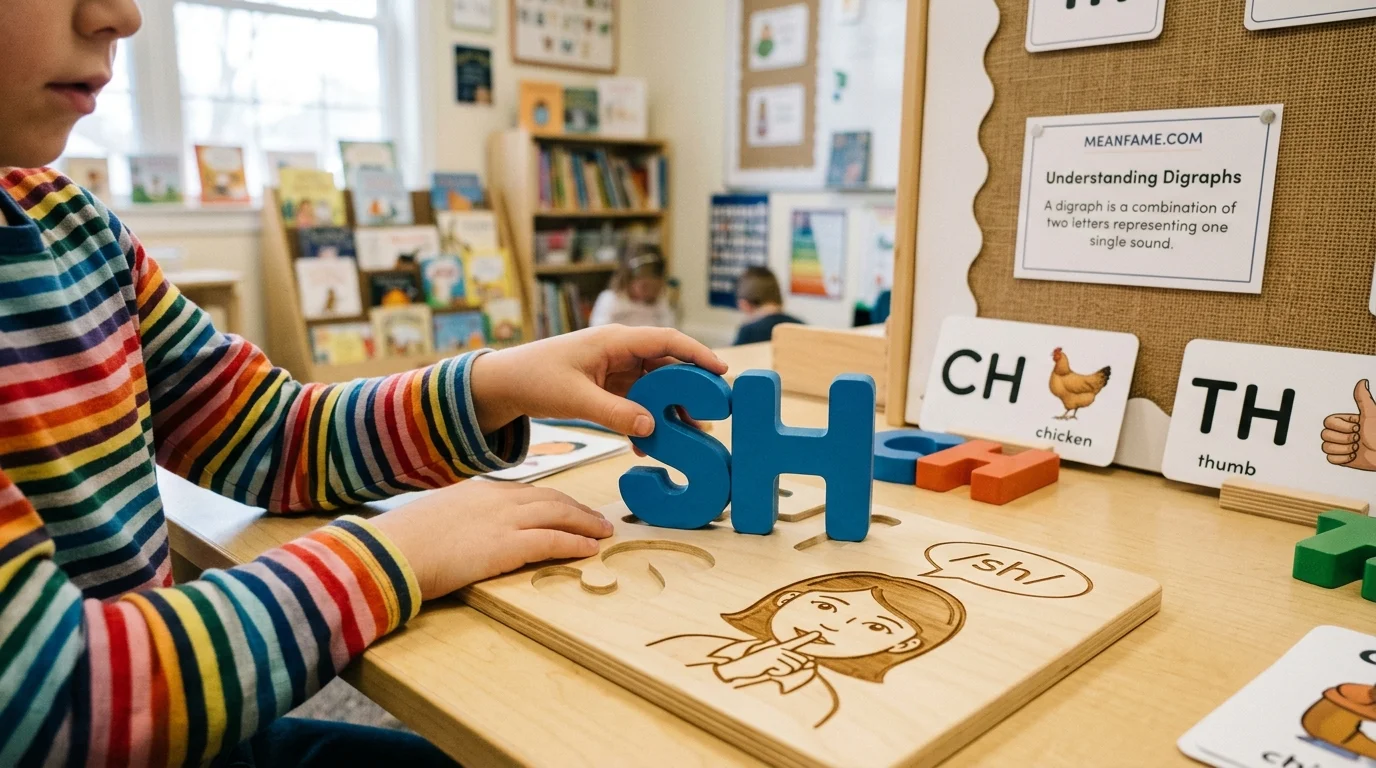
What Does “Digraph” Mean?
A digraph is a combination of two letters that together represent one speech sound (phoneme).
Quick Definition
Digraph: Two letters that work together to produce a single sound.
Literal Meaning
The word digraph comes from:
- Di- = two
- Graph = written symbol or letter
Together, digraph literally means “two written letters.”
Why Digraphs Matter
Digraphs help readers:
- Recognize word patterns
- Improve pronunciation
- Read more fluently
- Spell accurately
- Build phonics skills
How Does a Digraph Work?
Normally, each letter has its own sound.
For example:
- c = /k/
- h = /h/
But together:
- ch = /ch/
The two letters create one sound, not two separate sounds.
Common Types of Digraphs
Consonant Digraphs
These combine two consonants to produce one consonant sound.
Examples:
| Digraph | Example Word | Sound |
|---|---|---|
| sh | ship | /sh/ |
| ch | chair | /ch/ |
| th | think | /th/ |
| ph | phone | /f/ |
| wh | whale | /w/ (in most accents) |
| ck | duck | /k/ |
| ng | sing | /ng/ |
Vowel Digraphs
These combine two vowels to produce one vowel sound.
Examples:
| Digraph | Example Word | Sound |
| ai | rain | Long A |
| ea | bread | Short E or Long E (depending on the word) |
| ee | tree | Long E |
| oa | boat | Long O |
| oo | moon | Long OO |
| ay | play | Long A |
| ie | field | Long E (in many words) |
Examples of Digraphs in Everyday Words
Here are some common examples.
SH
- ship
- shop
- fish
- brush
CH
- chair
- chicken
- chocolate
- teacher
TH
- think
- thumb
- bath
- three
PH
- phone
- photograph
- pharmacy
- elephant
WH
- wheel
- white
- whale
- whisper
EE
- tree
- green
- sleep
- feet
OO
- moon
- school
- spoon
- room
Digraph vs. Blend
Many learners confuse digraphs with blends.
| Digraph | Blend |
| Two letters make one sound | Two letters keep their individual sounds |
| ship (sh) | stop (st) |
| chair (ch) | black (bl) |
| think (th) | frog (fr) |
Example
ship
- sh = one sound
stop
- s and t are both heard separately
That’s why sh is a digraph, while st is a consonant blend.
How Digraphs Help Reading
Learning digraphs helps children:
- Decode unfamiliar words
- Improve reading speed
- Build spelling confidence
- Recognize common sound patterns
- Develop stronger phonics skills
Teachers often introduce digraphs early because they appear frequently in English.
Real-Life Examples
Example 1
Teacher: What sound do the letters “sh” make?
Student: /sh/ like in “ship.”
Example 2
Parent: Can you read “chair”?
Child: It starts with the “ch” sound.
Example 3
Teacher: Is “th” one sound or two?
Student: One sound.
Example 4
Student: “Phone” starts with the /f/ sound.
Teacher: Correct! That’s because “ph” is a digraph.
Example 5
Parent: Read the word “tree.”
Child: I see “ee,” which makes the long E sound.
Common Mistakes
Mistake: Every pair of letters is a digraph.
Correct: Only pairs that represent one sound are digraphs.
Mistake: Digraphs and blends are the same.
Correct: Blends keep both sounds; digraphs create one sound.
Mistake: Digraphs only involve consonants.
Correct: English has both consonant and vowel digraphs.
Mistake: Every digraph always has the same pronunciation.
Correct: Some digraphs, such as ea, can have different sounds depending on the word.
Related Phonics Terms
| Term | Meaning | Difference |
| Blend | Two or more sounds pronounced together | Each sound remains separate |
| Phoneme | Smallest unit of sound | A digraph represents one phoneme |
| Grapheme | Written symbol representing a sound | A digraph is a two-letter grapheme |
| Trigraph | Three letters making one sound | Uses three letters instead of two |
| Diphthong | A vowel sound that glides between two sounds | Refers to speech sounds rather than letter combinations |
| Syllable | Unit of pronunciation | Larger than a phoneme |
| Phonics | Method of teaching reading | Includes digraph instruction |
| Alphabet | Set of letters | Digraphs combine letters |
Why Are Digraphs Important?
Digraphs are one of the building blocks of reading.
They help learners:
- Recognize spelling patterns
- Improve pronunciation
- Read unfamiliar words
- Strengthen writing skills
- Increase reading confidence
Because many high-frequency English words contain digraphs, mastering them makes reading easier.