
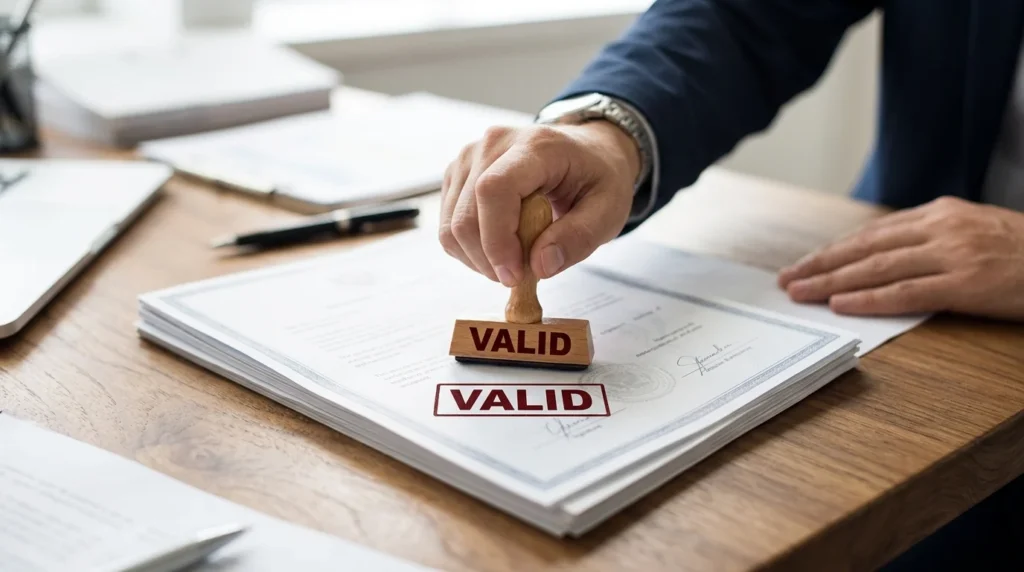

What Does “Validity” Mean?
The primary validity meaning is the state or quality of being valid, genuine, accurate, or legally acceptable.
The exact meaning depends on the context.
Quick Definition
Validity = The quality of being legally effective, logically sound, factually accurate, or suitable for its intended purpose.
What It Usually Means in Everyday Conversations
When someone says:
“I’m questioning the validity of that claim.”
They usually mean:
“I’m not sure the claim is true or reliable.”
Another example:
“Check the validity of your passport.”
Meaning:
“Make sure your passport hasn’t expired and is still officially valid.”
What Tone Does It Convey?
Depending on the context, validity is generally:
- Neutral
- Professional
- Academic
- Legal
- Analytical
What Does Validity Mean in Different Contexts?
Everyday English
People use validity when discussing whether something is correct, believable, or acceptable.
Example:
“The validity of that rumor is unclear.”
Law
In legal settings, validity refers to whether a document, agreement, contract, or marriage is legally recognized.
Example:
“The court examined the validity of the contract.”
Research and Science
Researchers use validity to describe whether a study or experiment accurately measures what it claims to measure.
Example:
“The survey has high validity.”
Education
Teachers and testing experts discuss the validity of exams to determine whether they accurately assess students’ knowledge or skills.
Business
Companies may refer to the validity of licenses, warranties, certifications, or agreements.
Technology
Software and online systems often verify the validity of:
- Login credentials
- Security certificates
- Digital signatures
- User input
Origin and History of Validity
The word validity comes from the Latin word validus, meaning strong, effective, or powerful. It entered English through the word valid, eventually developing into the noun validity, which describes the condition of being valid.
Over time, the word became widely used in law, philosophy, science, education, and everyday English to evaluate whether something is accurate, reliable, or officially recognized.
Today, validity remains an important concept across many professional and academic fields.
How People Actually Use Validity
People commonly use validity when discussing:
- Documents
- Research
- Arguments
- Contracts
- Certificates
- Licenses
- Passports
- Scientific studies
Common expressions include:
- Validity of a contract
- Validity of a passport
- Validity of a claim
- Validity of a test
- Validity of an argument
- Validity period
When to Use It
Use validity when referring to:
- Whether something is legally recognized.
- Whether information is accurate.
- Whether research is reliable.
- Whether a document is still effective.
When Not to Use It
Avoid using validity when discussing personal opinions that don’t involve truth, accuracy, or official recognition.
Real Examples of Validity in Conversations
Example 1
Person A: Is my passport still good?
Person B: Check its validity date.
Meaning: Verify that it hasn’t expired.
Why it was used: Official document.
Example 2
Person A: Can we trust this survey?
Person B: Researchers tested its validity.
Meaning: They confirmed it accurately measures what it claims to measure.
Example 3
Person A: Is the contract legal?
Person B: The lawyer confirmed its validity.
Meaning: It is legally valid.
Example 4
Person A: I don’t believe that rumor.
Person B: Neither do I—its validity is questionable.
Meaning: Its truth is uncertain.
Example 5
Person A: Does my driver’s license still work?
Person B: Yes, it’s within its validity period.
Meaning: It hasn’t expired.
Example 6
Person A: Was the exam fair?
Person B: Experts reviewed its validity.
Meaning: They assessed whether it measured students accurately.
Example 7
Person A: The website rejected my certificate.
Person B: It may have failed the validity check.
Meaning: It wasn’t accepted as authentic.
Example 8
Person A: Are those statistics accurate?
Person B: Their validity is still being reviewed.
Meaning: Their accuracy hasn’t been confirmed yet.
Example 9
Person A: Is this warranty still active?
Person B: Yes, it’s still within its validity period.
Meaning: It’s still effective.
Example 10
Person A: Does this argument make sense?
Person B: Let’s examine its validity.
Meaning: Evaluate whether it’s logically sound.
Common Mistakes and Misunderstandings
Mistake 1
Confusing validity with reliability.
A test can be reliable (consistent) without being valid (accurately measuring what it’s supposed to measure).
Mistake 2
Thinking validity only applies to legal documents.
It also applies to research, arguments, scientific findings, exams, and data.
Mistake 3
Using validity instead of value.
Validity concerns correctness or legitimacy, not usefulness or worth.
Mistake 4
Assuming validity always means truth.
In some contexts, validity refers to legal recognition or logical structure rather than factual accuracy.
Similar Words and Related Terms
| Word | Meaning | Difference |
|---|---|---|
| Valid | Legally or logically acceptable | Adjective form |
| Legitimacy | Lawful or genuine status | Focuses on legal or official recognition |
| Authenticity | Genuine or real | Emphasizes originality |
| Reliability | Consistency and dependability | Different from validity |
| Accuracy | Correctness | More specific to factual correctness |
| Credibility | Believability | Focuses on trustworthiness |
| Soundness | Logical correctness | Often used for arguments |
| Legality | Compliance with the law | Narrower than validity |
| Effectiveness | Ability to produce results | Doesn’t necessarily imply validity |
| Verification | Process of confirming truth | Action rather than quality |
Internal linking opportunities: valid meaning, reliability meaning, authenticity meaning, credibility meaning, accuracy meaning.
Is Validity Positive, Negative, or Neutral?
Validity is generally a neutral word.
It becomes positive or negative depending on the context.
Positive:
- High validity
- Proven validity
- Confirmed validity
Negative:
- Questionable validity
- Limited validity
- Invalid claim
Neutral:
- Validity period
- Test validity
- Legal validity
Should You Use Validity?
Yes, especially in formal, academic, legal, scientific, and professional writing.
Use it if:
- You’re discussing documents.
- You’re evaluating research.
- You’re talking about legal agreements.
- You’re assessing whether something is accurate or legitimate.
Avoid it if:
- A simpler word like “truth,” “accuracy,” or “correctness” better fits your audience.
- You’re writing very informal conversations where “valid” or “real” may sound more natural