

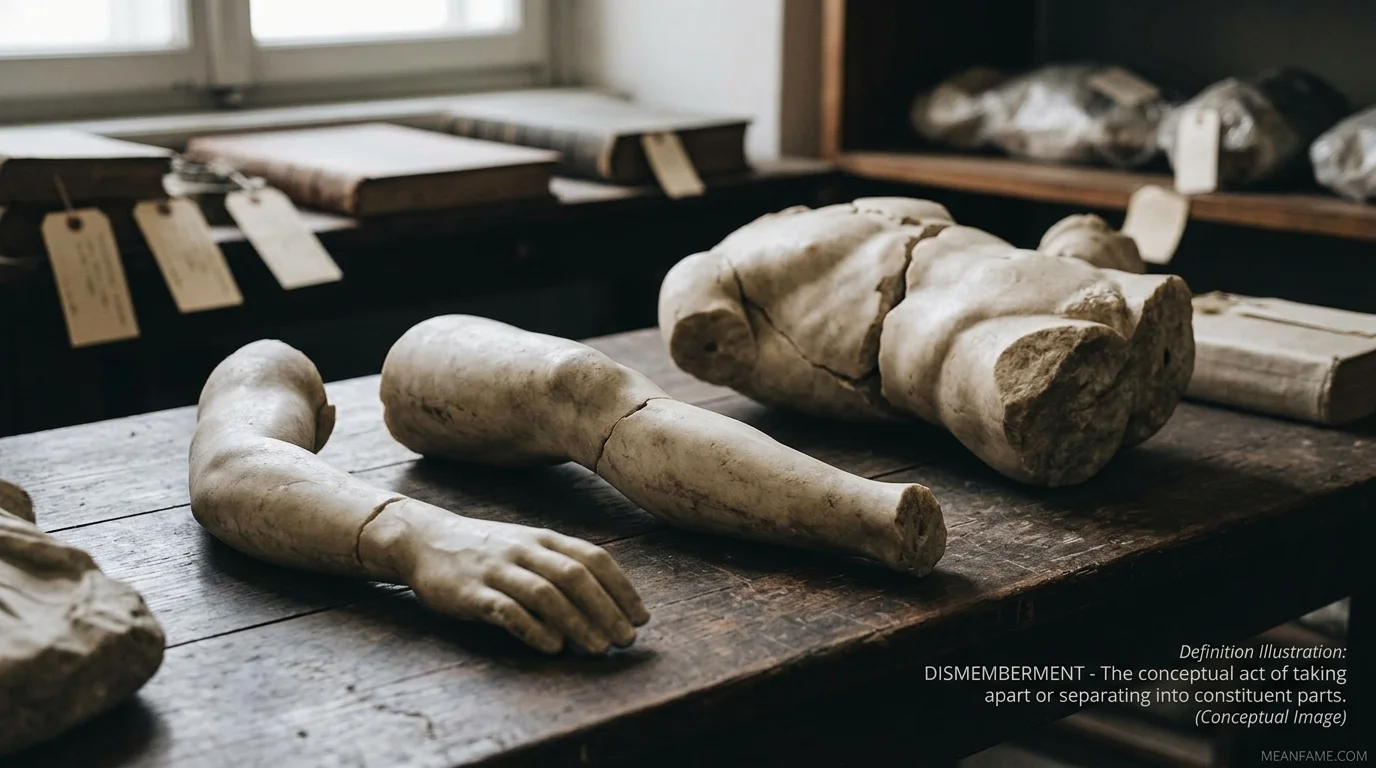
What Does “Dismemberment” Mean?
Quick Definition
Dismemberment means the separation or removal of limbs or other body parts from a body, or, in a figurative sense, the breaking apart of something into separate pieces.
What It Usually Means
The term commonly refers to:
- Severe physical injury
- Traumatic accidents
- Forensic investigations
- Medical documentation
- Legal cases
- Figurative division of organizations or territories
Literal Meaning
The literal meaning involves the physical separation of limbs or major body parts.
Figurative Meaning
The word can also describe the division or breakup of a country, organization, or institution.
Example:
“The dismemberment of the empire changed the region’s political landscape.”
What Tone Does It Convey?
The word often conveys:
- Seriousness
- Trauma
- Violence
- Medical precision
- Historical significance
What Does Dismemberment Mean in Different Contexts?
Medicine
Medical professionals may use the term when documenting severe traumatic injuries or discussing emergency treatment.
Law and Forensics
The word may appear in legal proceedings or forensic reports describing criminal investigations or evidence.
History
Historians sometimes use dismemberment figuratively to describe the division of nations, kingdoms, or empires.
Literature and Film
Writers may use the word in horror, crime, or historical fiction, either literally or metaphorically.
Origin and History of Dismemberment
The word dismemberment comes from the Old French word desmembrer, meaning “to separate into parts.” It entered English during the Middle Ages and originally referred both to the physical removal of limbs and the division of territories or political entities.
Today, while the literal meaning remains common in medical and legal contexts, the figurative sense is also widely used in history and political writing.
How People Actually Use Dismemberment
Meaning 1: Medical Injury
Example:
“The accident resulted in traumatic dismemberment.”
Meaning:
Severe physical injury involving the loss of a limb.
Meaning 2: Criminal Investigation
Example:
“The investigation examined evidence related to alleged dismemberment.”
Meaning:
A forensic or legal context.
Meaning 3: Historical Division
Example:
“The dismemberment of the kingdom reshaped Europe.”
Meaning:
The breakup of a political entity.
When People Use It
You’ll most often encounter dismemberment in:
- Medical reports
- Legal documents
- History books
- Crime fiction
- News reporting
- Academic writing
Real Examples of Dismemberment in Conversations
Example 1
Student: What does dismemberment mean?
Teacher: It refers to the separation of limbs or, figuratively, the breakup of something into parts.
Meaning: Vocabulary explanation.
Why it was used: Education.
Example 2
Historian: The treaty led to the dismemberment of the empire.
Meaning: Political division.
Why it was used: History discussion.
Example 3
Doctor: The patient suffered severe injuries.
Meaning: Medical context.
Why it was used: Healthcare discussion.
Example 4
Reader: The novel mentions dismemberment during the war.
Meaning: Historical or fictional event.
Why it was used: Literature.
Example 5
Journalist: The report described the case using formal legal terminology.
Meaning: Legal reporting.
Why it was used: News coverage.
Example 6
Professor: The word also has a figurative meaning.
Meaning: Division or breakup.
Why it was used: Language lesson.
Example 7
Researcher: Historical texts often use dismemberment metaphorically.
Meaning: Territorial division.
Why it was used: Academic discussion.
Example 8
Law Student: Context is important when interpreting the word.
Meaning: Literal vs. figurative use.
Why it was used: Legal education.
Example 9
Author: The empire’s dismemberment changed history.
Meaning: Political fragmentation.
Why it was used: Historical writing.
Example 10
Editor: Use the term carefully because it describes a serious subject.
Meaning: Appropriate language choice.
Why it was used: Writing advice.
Common Mistakes and Misunderstandings
Mistake 1: Assuming It Always Refers to Crime
While the word can appear in criminal investigations, it may also describe accidental injuries, medical situations, or historical events.
Mistake 2: Ignoring the Figurative Meaning
Dismemberment can refer to the division of countries, organizations, or institutions—not only physical injuries.
Mistake 3: Using It Casually
Because the term describes severe situations, it is generally inappropriate for lighthearted or everyday contexts.
Mistake 4: Confusing It with Amputation
An amputation is a medical procedure or the loss of a limb, while dismemberment is a broader term describing the separation of body parts and is often used in legal, forensic, or historical contexts.
Similar Words and Related Terms
| Word | Meaning | Difference |
|---|---|---|
| Dismemberment | Separation of body parts or figurative division | Main concept |
| Amputation | Surgical or traumatic removal of a limb | Medical term |
| Severance | Separation or cutting off | Broader meaning |
| Dissection | Careful separation for study | Scientific context |
| Fragmentation | Breaking into smaller pieces | Usually figurative |
| Division | Separation into parts | General term |
| Separation | Moving apart | Broad meaning |
| Partition | Political or territorial division | Geographic context |
| Injury | Physical harm | Broader category |
| Trauma | Serious physical or emotional injury | Wider meaning |
Is Dismemberment Positive, Negative, or Neutral?
The dismemberment meaning is generally negative because it refers to severe injury, violence, or the breakup of something significant.
Negative Associations
- Serious injury
- Trauma
- Violence
- Loss
- Destruction
Neutral Use
In academic, medical, legal, or historical writing, the word may be used as a neutral descriptive term without emotional intent.
Should You Use the Word Dismemberment?
Use It If
- You’re discussing medical, legal, or historical topics.
- You’re writing formally.
- The context requires precise terminology.
- You’re referring to the figurative breakup of a nation or organization.
Avoid It If
- A less graphic or simpler word would communicate your meaning more appropriately.
- You’re speaking in a casual or humorous context