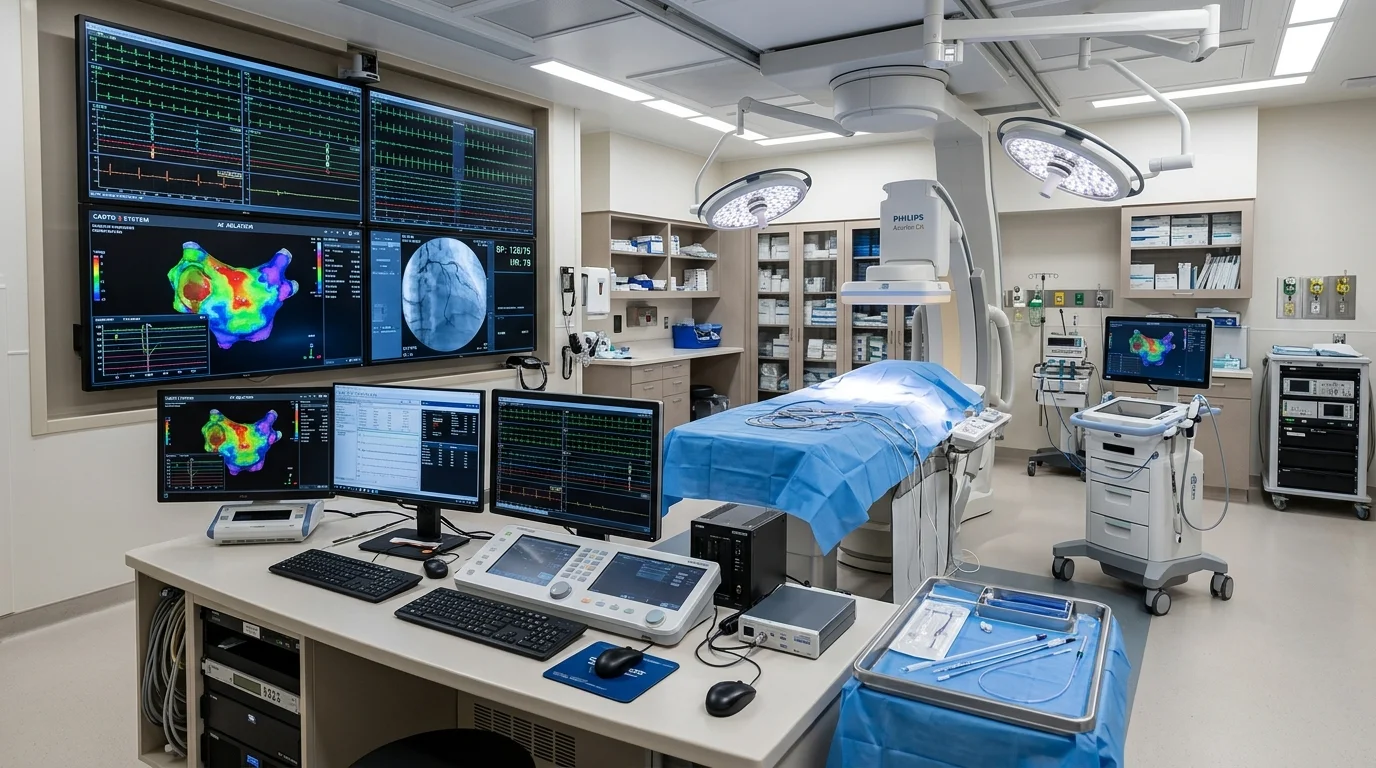
What Does “Heart Ablation” Mean?
Quick Definition
Heart ablation (also called cardiac ablation) is a procedure that uses heat or cold energy to destroy small areas of heart tissue causing irregular heartbeats. It creates scar tissue that blocks abnormal electrical signals, allowing the heart to beat normally again.
What It Usually Means In Conversations
When people talk about the heart ablation meaning in everyday conversation, they’re usually referring to one of these things:
The treatment: A procedure to fix heart rhythm problems (arrhythmias) when medications don’t work. This is the most common heart ablation meaning in medical discussions.
The procedure itself: A minimally invasive procedure where thin tubes called catheters are guided through blood vessels to the heart. The heart ablation meaning includes the entire process of identifying and destroying problem tissue.
The type of energy used: Two main methods exist—radiofrequency ablation (using heat) and cryoablation (using extreme cold). Understanding the heart ablation meaning includes knowing which type is used for your condition.
What Tone Does It Convey?
The tone of heart ablation depends on the context:
| Context | Tone | Example |
|---|---|---|
| Medical/Clinical | Professional, factual | “Radiofrequency ablation is the most common method” |
| Patient education | Supportive, reassuring | “Most people return to normal activities within days” |
| Personal experience | Empowering, relieved | “After my ablation, my heart feels normal again” |
Why Is Heart Ablation Done?
Understanding the heart ablation meaning starts with knowing why it’s recommended. Cardiac ablation is used to treat arrhythmias—problems with the rate or rhythm of your heartbeat. An arrhythmia happens when the electrical signals that tell the heart to beat don’t work as they should.
Conditions Treated
Healthcare professionals may recommend cardiac ablation if:
Medicines don’t work: You have an irregular heartbeat that doesn’t respond to medication
Medications cause side effects: You experience serious side effects from arrhythmia medications
You have a specific treatable condition: Certain arrhythmias respond very well to ablation, including:
Atrial fibrillation (AFib): Abnormal heartbeat in the upper chambers of the heart
Atrial flutter: Fast but regular heartbeat in the upper chambers
Supraventricular tachycardia (SVT): Fast heart rhythms originating above the ventricles
Wolff-Parkinson-White syndrome: A condition with an extra electrical pathway
Ventricular tachycardia: Life-threatening fast rhythm in the lower chambers
Common Symptoms Addressed
Heart ablation aims to relieve symptoms such as:
Palpitations (feeling your heart race or skip beats)
Dizziness or lightheadedness
Shortness of breath
Chest pain
Fainting
How Heart Ablation Works
The Two Main Methods
There are two primary methods for performing cardiac ablation, which are central to the heart ablation meaning:
| Method | Energy Used | How It Works |
|---|---|---|
| Radiofrequency ablation | Heat energy | Uses high-frequency electrical energy to heat and destroy targeted tissue |
| Cryoablation | Extreme cold | Uses freezing temperatures to destroy abnormal tissue |
Other less common methods include:
Laser ablation: Uses laser energy to destroy tissue
Pulsed field ablation: Uses high-voltage electric shocks
Before the Procedure
Preparation for heart ablation involves several steps:
Testing: Your doctor will perform an electrophysiology (EP) study to map your heart’s electrical system and pinpoint the problem area
Medication instructions: Your doctor will tell you which medicines to take or stop before the procedure
Fasting: You’ll typically be asked not to eat or drink after midnight the night before
Arrival: You’ll be told when to arrive at the hospital
During the Procedure
Here’s what happens during cardiac ablation, the core of the heart ablation meaning:
Sedation: You receive medication to help you relax. Some people are fully awake with light sedation, while others receive general anesthesia.
Catheter insertion: The doctor inserts thin, flexible tubes called catheters through a blood vessel, usually in the groin (less commonly, the neck or arm).
Guiding to the heart: Using live X-ray images, the doctor carefully guides the catheters up into your heart.
Finding the problem: Sensors on the catheter tips record the heart’s electrical activity to identify the exact area causing the arrhythmia.
Ablation: Once the problem area is found, the doctor uses heat, cold, or other energy to destroy the tiny area (about one-fifth of an inch).
The procedure typically takes 2 to 6 hours, depending on the complexity of your arrhythmia.
After the Procedure
Recovery after heart ablation usually involves:
Resting: You’ll need to lie still for 2 to 6 hours to reduce bleeding risk
Monitoring: Your heart rhythm will be closely monitored
Going home: Some people go home the same day, others stay overnight
Common symptoms: You may experience fatigue, mild chest discomfort, bruising at the catheter site, or irregular heartbeats for a few days
Returning to activities: Most people return to normal activities within a few days. Avoid heavy lifting for about a week
Success Rates and Results
Understanding the heart ablation meaning includes knowing what to expect in terms of outcomes:
Success Rates
The success of ablation depends on the type of arrhythmia being treated:
| Arrhythmia Type | Success Rate |
|---|---|
| Supraventricular tachycardias | 90 to 95% |
| Atrial flutter | Up to 98% |
| Atrial fibrillation | 60 to 80% for more difficult cases |
| Ventricular tachycardia | 60 to 80% for more difficult cases |
What to Expect
Most people see improvement in their quality of life after cardiac ablation
There’s a chance the irregular heartbeat may return; if this happens, the treatment may be repeated or other treatments suggested
You may still need medications depending on your type of arrhythmia
Risks and Complications
While cardiac ablation is generally safe, it’s important to understand the potential risks:
Common Risks (Fewer than 5% of people develop problems)
Bleeding or infection where the catheter was inserted
Blood vessel damage
New arrhythmias or existing ones getting worse
Rare but Serious Risks
Stroke or heart attack
Fluid around the heart (cardiac tamponade)
Damage to heart valves
Narrowing of the veins that carry blood between the lungs and heart (pulmonary vein stenosis)
Esophageal atrial fistula (connection forming between the esophagus and heart)
Damage to kidneys from contrast dye used during the procedure
Important: Discuss the risks and benefits with your healthcare team to understand if this treatment is right for you.
Real Examples of Heart Ablation in Conversations
Example 1: Doctor’s Recommendation
Person A: “My heart keeps racing and medications aren’t helping.”
Person B: “Your doctor might recommend cardiac ablation to fix the problem.”
Meaning: Discussing the treatment option.
Why it was used: To explain the heart ablation meaning.
Example 2: Patient Discussion
Person A: “What exactly happens during an ablation?”
Person B: “They put a tube through a vein in your groin up to your heart and use heat to scar the problem area.”
Meaning: Explaining the procedure.
Why it was used: To describe what to expect.
Example 3: Recovery Talk
Person A: “How did your ablation go?”
Person B: “Great! I stayed overnight and felt fine within a few days.”
Meaning: Sharing recovery experience.
Why it was used: To provide reassurance.
Example 4: Success Story
Person A: “I haven’t had any palpitations since my ablation.”
Person B: “That’s amazing. I’m so glad it worked for you.”
Meaning: Celebrating successful treatment.
Why it was used: To share a positive outcome.
Common Mistakes and Misunderstandings
Confusing Ablation with Open Heart Surgery
Myth: Cardiac ablation is major open-heart surgery.
Reality: It’s a minimally invasive procedure using catheters through blood vessels, not open surgery.
Thinking It’s Always a Cure
Myth: Ablation permanently fixes all heart rhythm problems.
Reality: While it has high success rates, some people may need the procedure again or still need medications.
Assuming It’s Highly Dangerous
Myth: Cardiac ablation is extremely risky.
Reality: Fewer than 5% of people develop problems, making it a relatively safe procedure.
Believing Recovery Takes Months
Myth: Recovery from ablation takes a long time.
Reality: Most people return to normal activities within a few days.
Similar Terms and Related Procedures
| Term | Meaning | Connection to Heart Ablation |
|---|---|---|
| Catheter ablation | Ablation performed via catheter | The most common type of ablation |
| Electrophysiology study (EP study) | Mapping the heart’s electrical system | Usually done before ablation |
| Radiofrequency ablation | Using heat energy to destroy tissue | The most common ablation method |
| Cryoablation | Using extreme cold to destroy tissue | Alternative method to radiofrequency |
| Pacemaker | Device that regulates heartbeat | May be needed if ablation causes slow heart rate |